Moving household goods is one of the most regulated jobs in trucking. This 22-chapter course walks you through every federal step in order, from forming your business to your first 90 days on the road: USDOT number, operating authority, insurance filings, your tariff, estimates, customer paperwork and the arbitration program.
Before you carry a single customer's belongings across state lines, federal law requires a USDOT number, household goods operating authority, a process agent, specific insurance filings, a published tariff, an arbitration program, and a stack of customer paperwork that has to be handed out at exactly the right time. Miss a step and you can face fines, lose your authority, or end up in a dispute you can't win. This course is built on the federal household goods rules in 49 CFR Part 375 and FMCSA's registration requirements, for people who want to do it right.
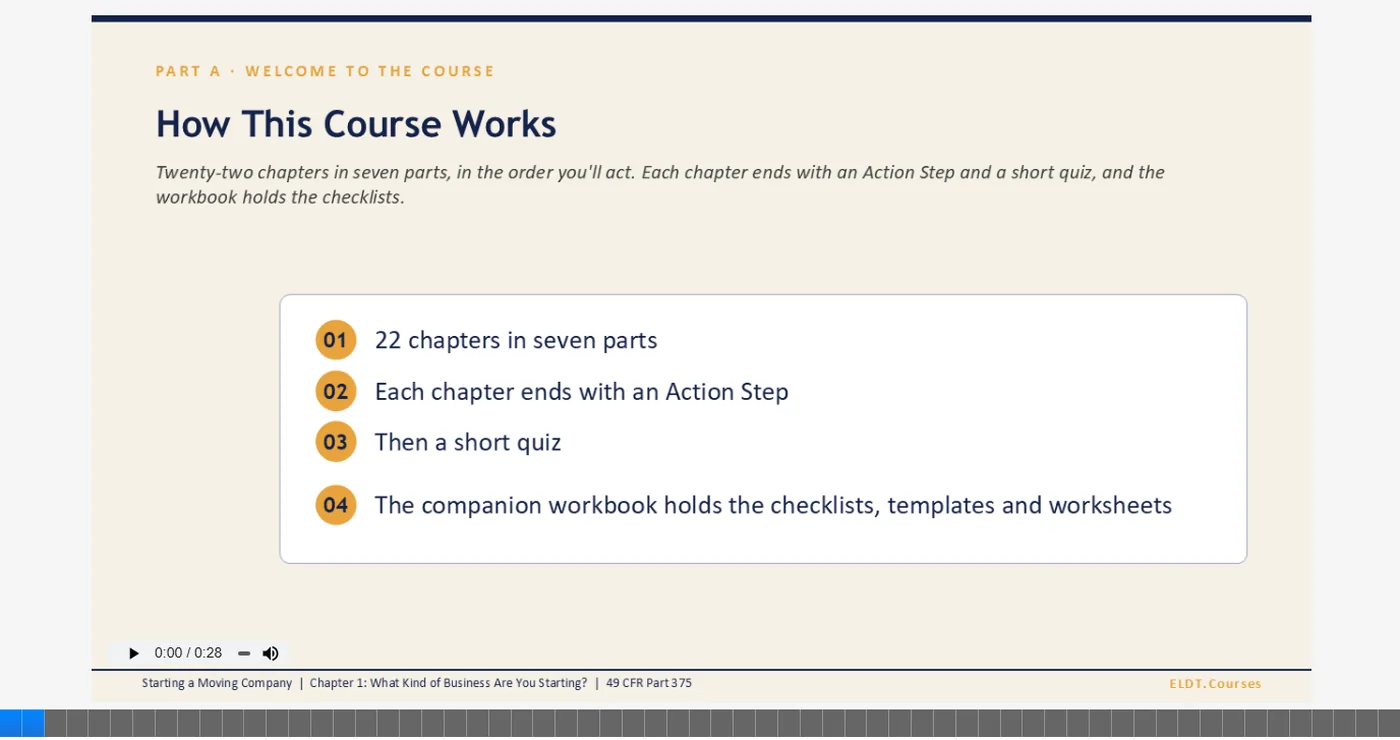
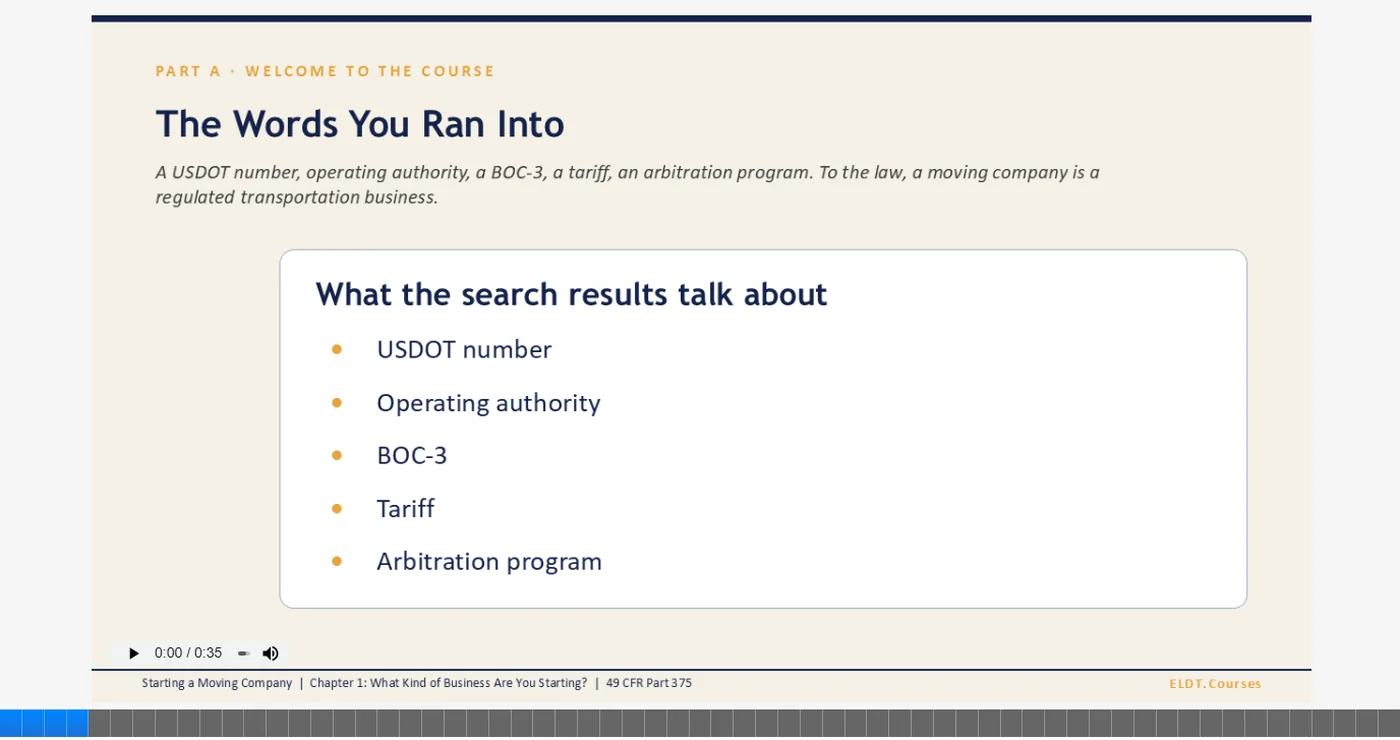
Real screens from Chapter 1 of this course, and the free practice app explaining each answer with the rule behind it. Everything works on a phone, a tablet or a computer, and you pick up where you left off.
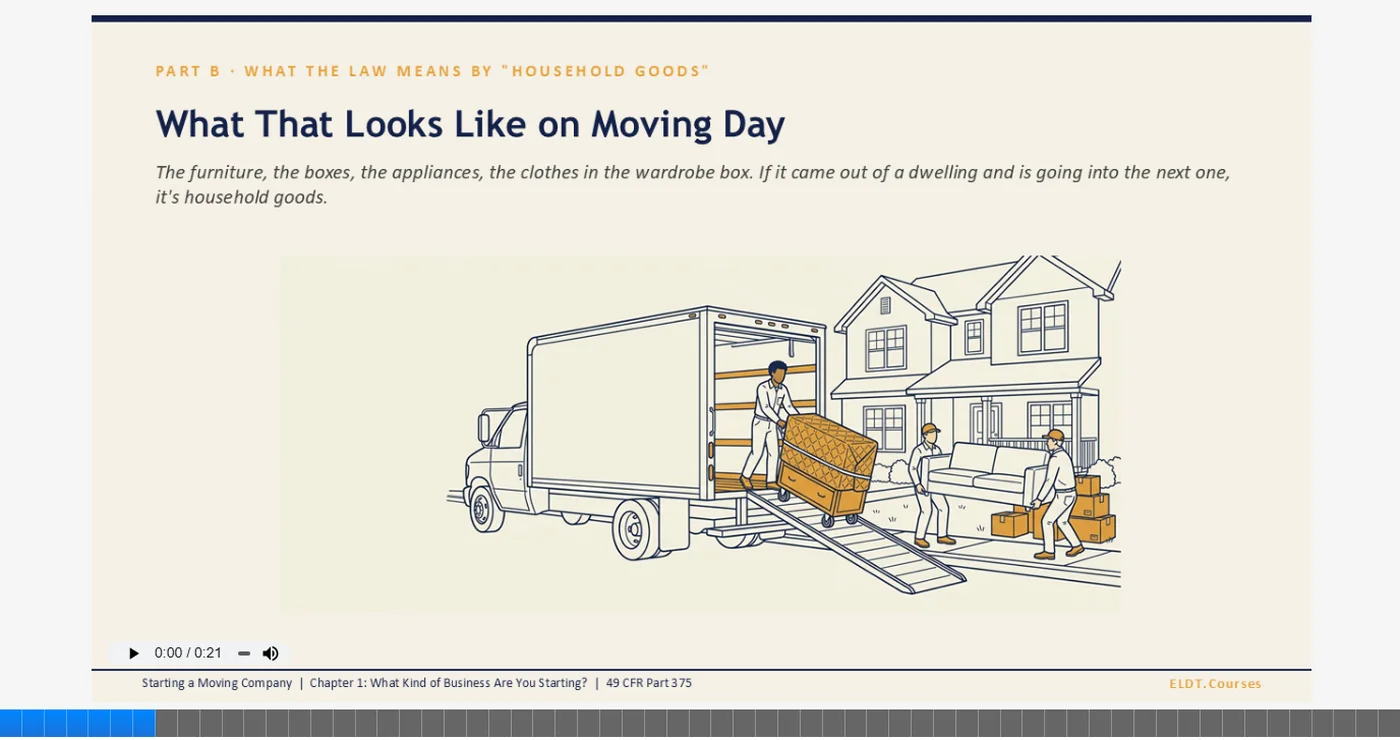
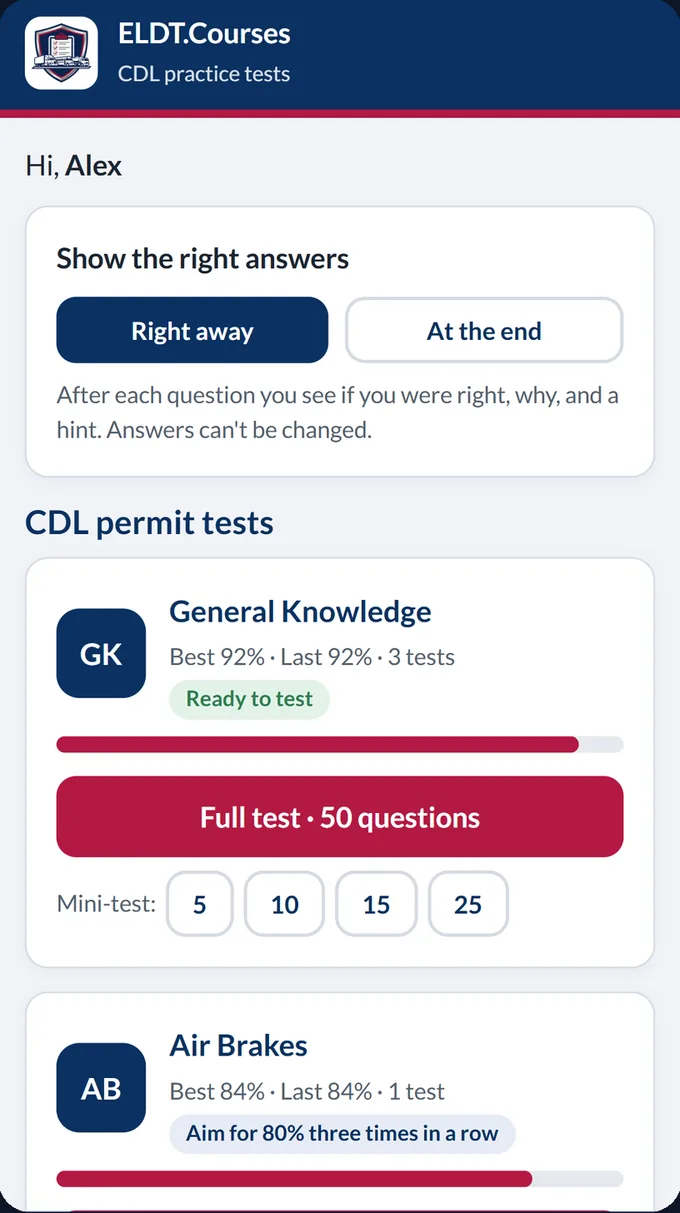
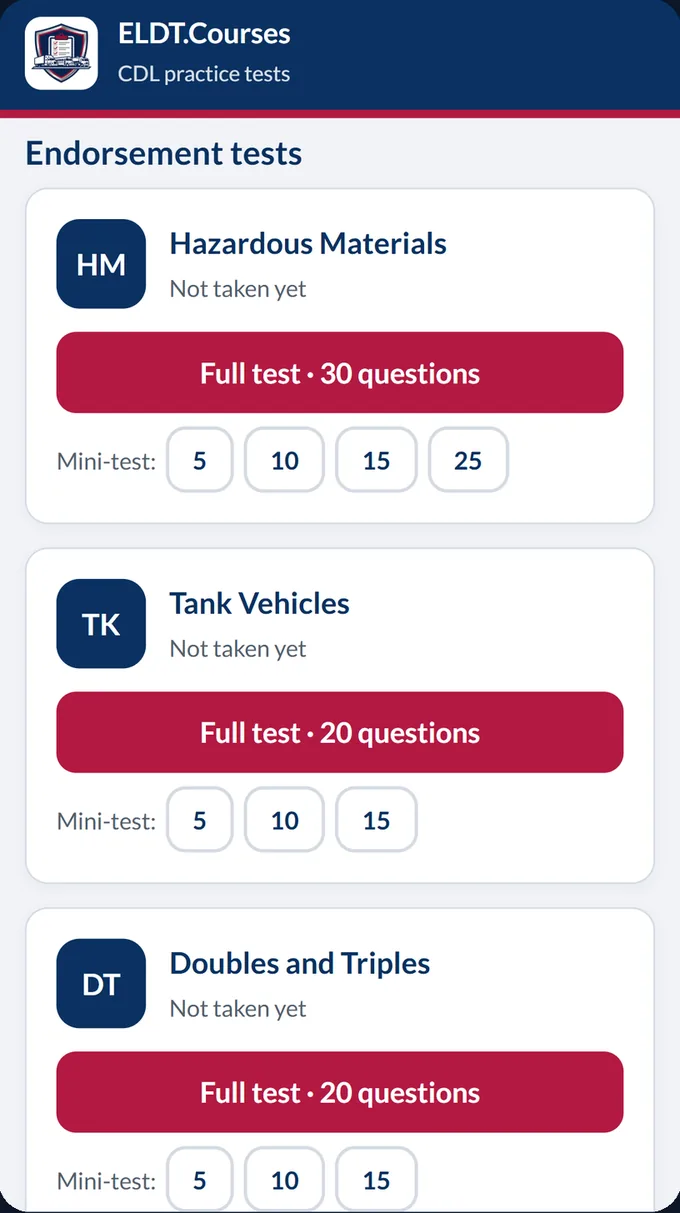
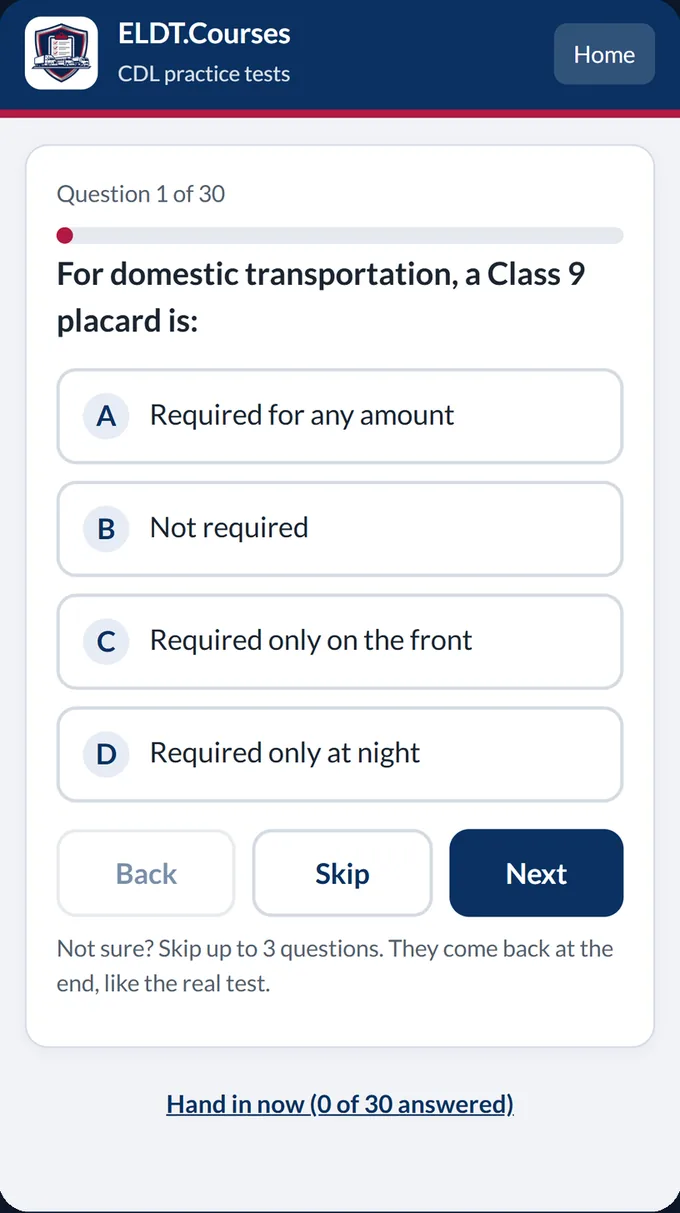
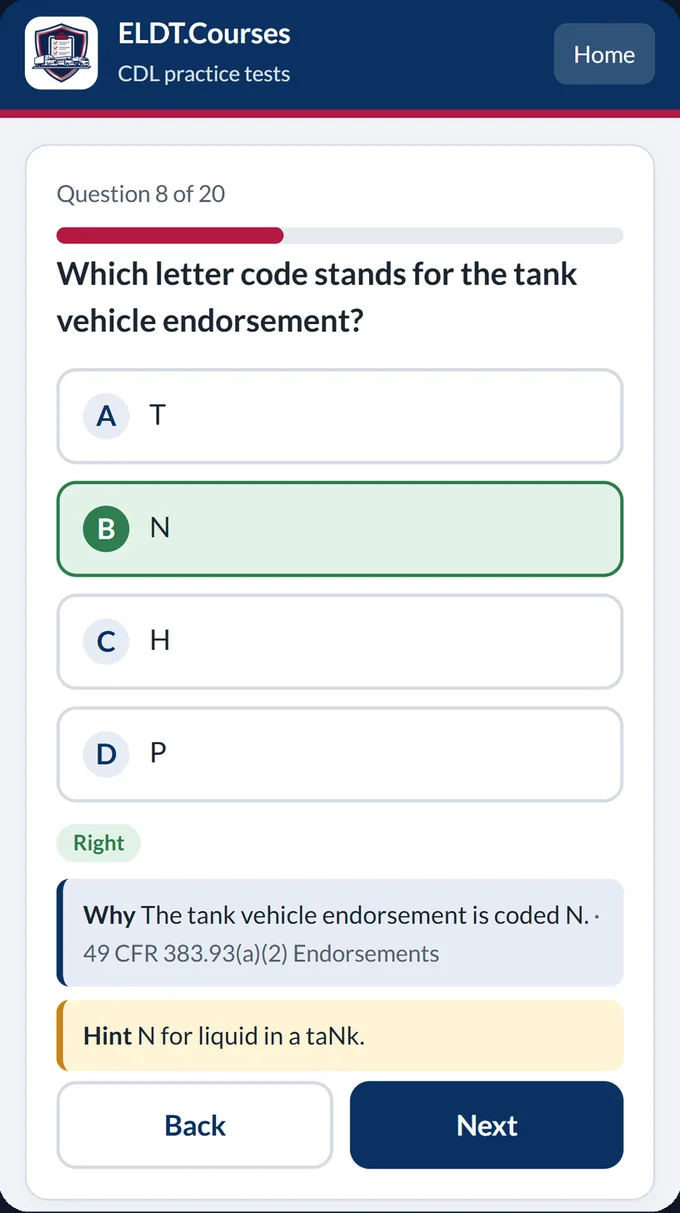
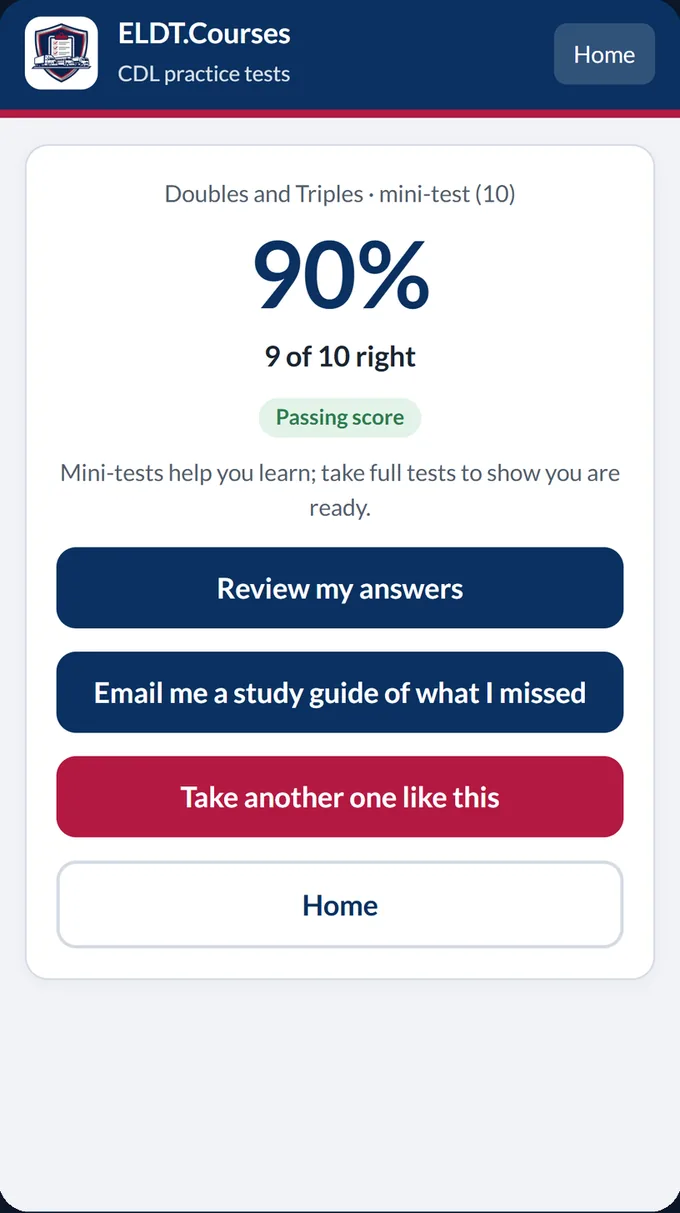
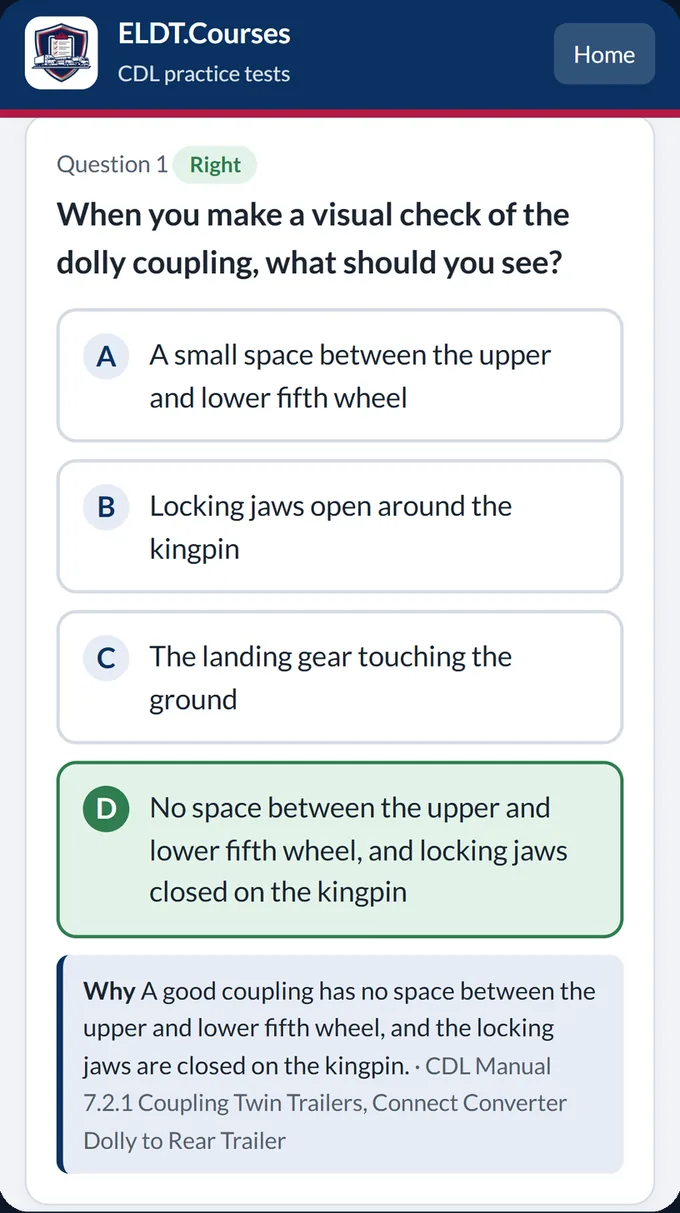
ELDT.Courses is listed on FMCSA's Training Provider Registry as an online theory provider. Search the registry for ELDT.Courses and you will find us, phone number and all: tpr.fmcsa.dot.gov/Search.
Every ELDT completion we report lands on your own driver record there by midnight of the second business day (49 CFR 380.717), so your state can see it before you test.
Anyone starting a household goods moving company — and the people who keep one compliant.
You're starting a household goods moving company and want every federal step in the order you'll take it, from forming the business to your first legal interstate move.
You're adding moving to your services, or you move locally now and want to expand into interstate work. The course shows what changes when household goods cross a state line.
You handle a mover's compliance: estimates, the document stack, driver files, the accident register and the filing calendar. The course gives you the rule behind each one.
Each chapter is a narrated lesson followed by a chapter test. Built on 49 CFR Part 375 and FMCSA's registration requirements, with the regulation behind every rule, and updated as rules and regulations change.
Interstate or intrastate, household goods or general freight, and why the difference decides every registration that follows.
Sole proprietorship, LLC or corporation, your Employer Identification Number, and matching your legal name and address exactly.
Why a for-hire household goods mover registers whatever its trucks weigh, FMCSA's registration system, and the biennial update.
The difference between the identifier and the permission, what FMCSA must find before it registers you, and when authority goes active.
The BOC-3, the blanket filing, and lining up your provider before you apply so the filing deadline doesn't catch you.
Public liability and cargo: the federal minimums, why movers file cargo coverage when freight carriers don't, and keeping both in force.
Why household goods movers still publish tariffs, what a tariff must contain, and why you can't charge more or less than it says.
Physical surveys, on-site or virtual, written waivers, binding and non-binding estimates, and what you can collect at delivery.
The whole document timeline from estimate to invoice, the required FMCSA publications, and every item on the bill of lading.
Why Congress requires neutral arbitration, which disputes it covers, and the minimum elements your program must have.
The federal weight lines that decide the license, driver qualification, drug testing and most of your compliance workload.
Which drivers need a Driver Qualification File, what makes a driver qualified, and building the file item by item.
When Part 382 reaches your company, the six kinds of tests, random testing, and your Clearinghouse duties.
The standard federal limits for property-carrying drivers, then the two short-haul exceptions that fit local moving work.
The annual inspection, qualified inspectors, driver vehicle inspection reports, and the maintenance records that prove it.
What counts as a recordable accident, the exclusions that describe everyday moving work, and keeping the register.
The New Entrant Safety Assurance Program, how the audit is run, the areas it reviews, and the automatic-failure violations.
What Unified Carrier Registration is, finding your base state and fee bracket, counting your vehicles, and renewing on time.
The thresholds for apportioned registration, fuel tax reporting and the heavy vehicle use tax, and what each requires once it applies.
Why federal authority stops at the state line, commercial-zone moves, and how to find out what your own state requires.
Advertising that meets §375.207, marking your trucks, and how customers check you out before they book.
The whole course as a calendar: the startup sequence, the filing clock after publication, and the routine that keeps your registration active.
22 narrated chapters with a test after each one. Self-paced, lifetime access, direct instructor support.
Enroll Now — $39 →Narrated lessons you can pause, replay and take at your own pace — with real examples throughout.
Every federal step from forming your business to your first 90 days on the road, in the order you'll take it.
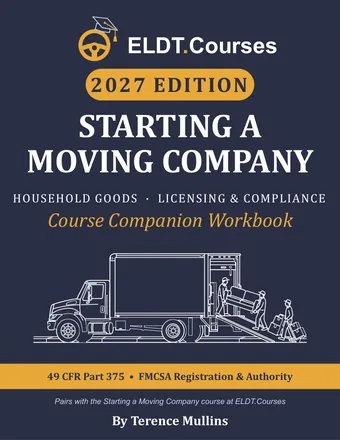
The course workbook is included as a PDF download inside the course at no extra charge.
80% to pass, unlimited retakes.
Sample estimates, the documents customers must receive, and a compliance calendar for your first three months.
Courses are updated as rules and regulations change — and enrolled students get the updates at no charge.
Stuck on a filing or a form? Email me. You're not a ticket number here.
Your access doesn't expire. Come back to the calendar chapter when your renewals come due.
When you finish, a certificate with your name, the course and your completion date is emailed to you automatically. It's yours to print and frame — a keepsake of the work you put in, not a license or a federal record.

I spent 10 years as an OTR driver and about 10 more in dispatch and driver recruiting before founding ELDT.Courses. This course explains what each requirement for a household goods mover is, why it exists, and when in your startup it has to happen.
Every chapter is built on primary sources — the federal regulations in 49 CFR and FMCSA's own registration requirements. Where the rules for in-state moves differ from state to state, the course tells you so and shows you how to find your own state's requirements.
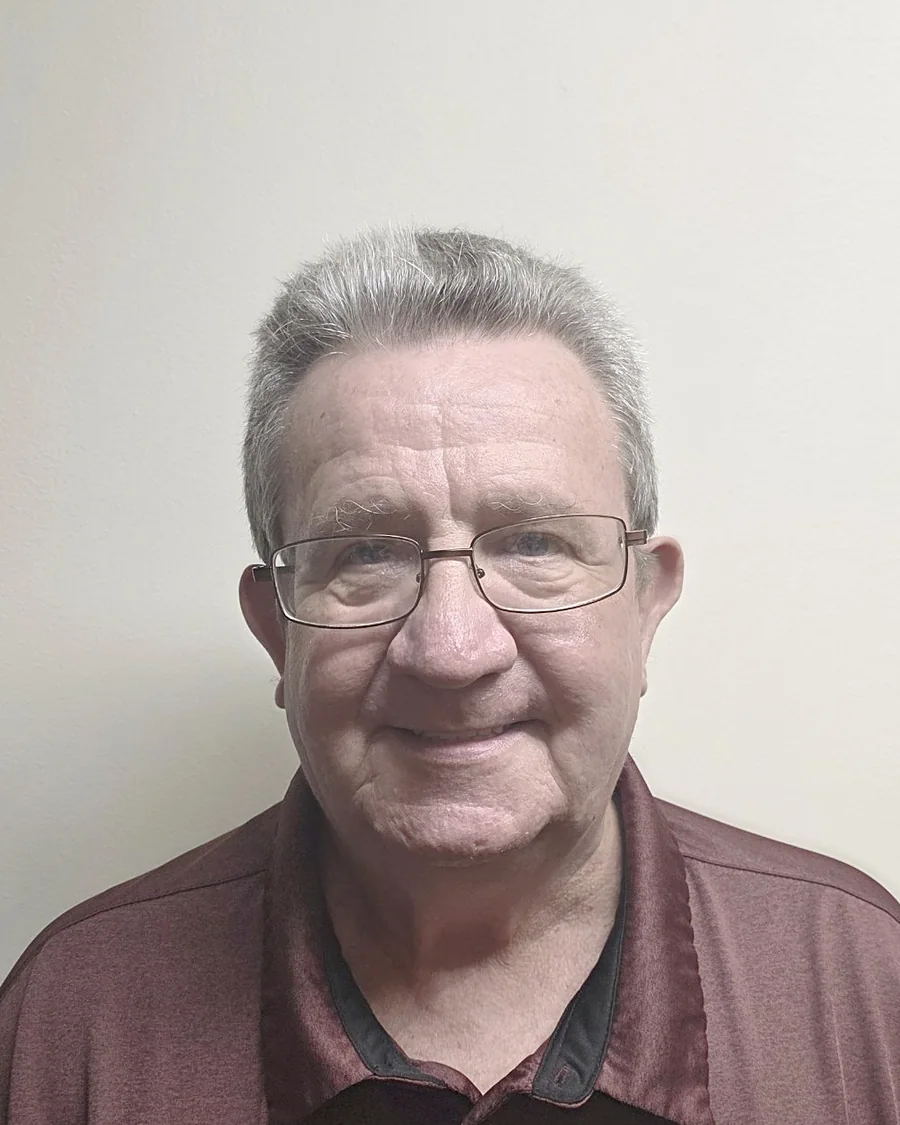
I've been around commercial trucking long enough to know what the standard endorsement course looks like — a recycled DMV manual, slow narration, and a quiz at the end. Drivers deserve better.
ELDT.Courses is what I wish I'd had when I was studying. Every chapter explains the why, not just the rule. Every quiz pulls from real test material. Every minute is paid for in attention, so I made sure none of them are wasted.
Have a question before you enroll? Pick a time and I will call you. Book a free phone call.
No. This is a business and regulatory course for people starting a household goods moving company. It is not Entry-Level Driver Training (ELDT), and nothing is submitted to the Training Provider Registry.
Anyone starting a household goods moving company, owner-operators adding moving to their services, small movers who want to expand from local to interstate work, and office managers and dispatchers who handle a mover's compliance.
The course teaches federal requirements. Rules for moves that start and end inside a single state vary from state to state, so Chapter 20 shows you how to find out what your own state requires before you take in-state moves.
If you move household goods across state lines for pay, yes. A for-hire household goods mover registers whatever its vehicles weigh, and even a van-only mover needs operating authority, a process agent, insurance filings, and must follow 49 CFR Part 375. Many of the driver and vehicle safety rules start at 10,001 pounds; Chapter 11 explains where those weight lines fall.
No. This course is for education only. It is not legal or tax advice, and FMCSA systems and fees change, so always confirm on FMCSA's website before you file.
Each of the 22 chapters ends with a test. You need 80% to pass, and you can retake any chapter test as many times as you need.
Try it risk-free. If you enroll and decide within 7 days that it's not for you — and you haven't started the course content — just email me and I'll refund you, no questions asked. Once you begin working through the material, the course is yours for life, including all future updates. Full terms are in our Terms of Service.
22 chapters. Built on 49 CFR Part 375. Lifetime access. Real instructor support.
Enroll Now — $39 →Questions before you enroll? Email terry@eldt.courses or call 1-814-304-7635.