
Getting a USDOT number is only the start. This 32-chapter course takes you through every federal step in order, from the decisions you make before you register to the end of your first year: operating authority, insurance filings, fuel and highway taxes, driver files, drug and alcohol testing, and the New Entrant Safety Audit.
A new motor carrier has to register correctly, keep its authority active, pay the right taxes, qualify its drivers, maintain its trucks, and pass the New Entrant Safety Audit. Miss a step and you can face fines or lose your authority. This course is built on the federal regulations in 49 CFR and FMCSA's own registration requirements, and it takes each requirement in the order you'll meet it.
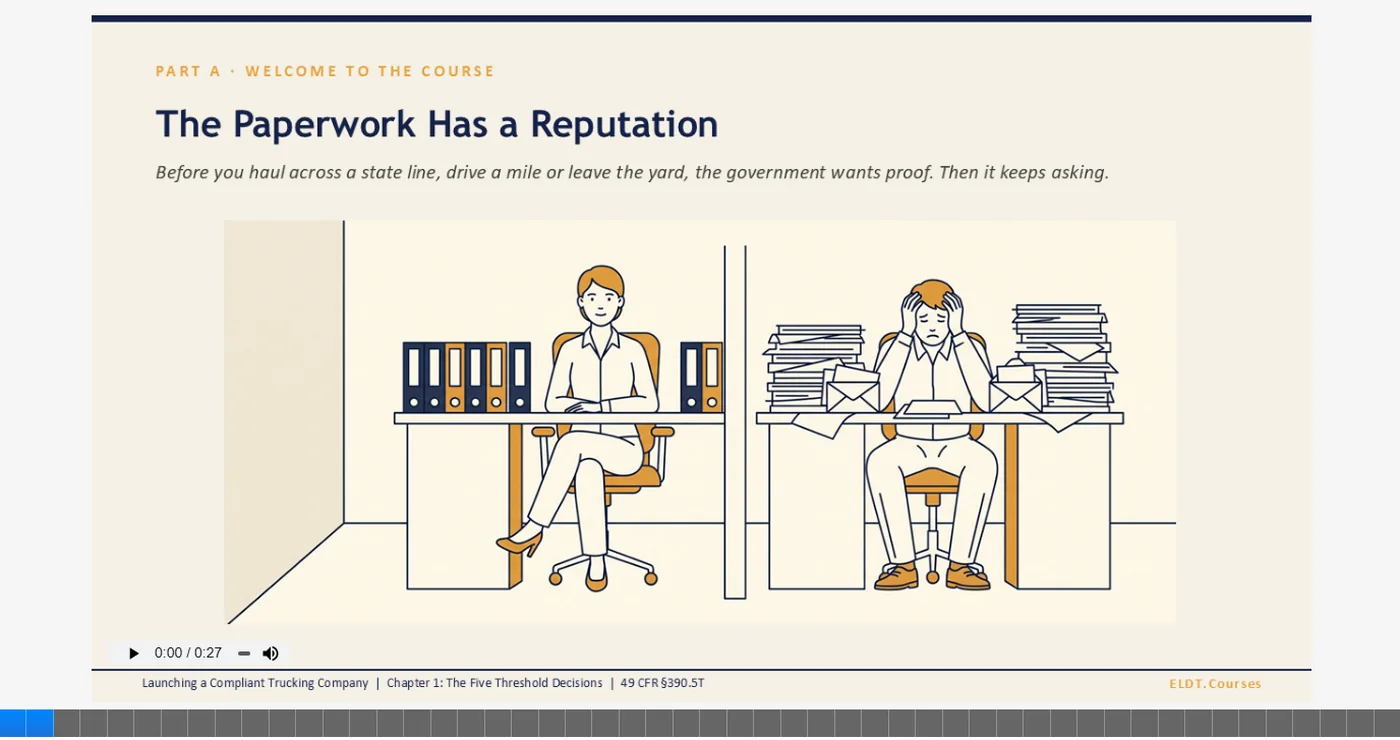
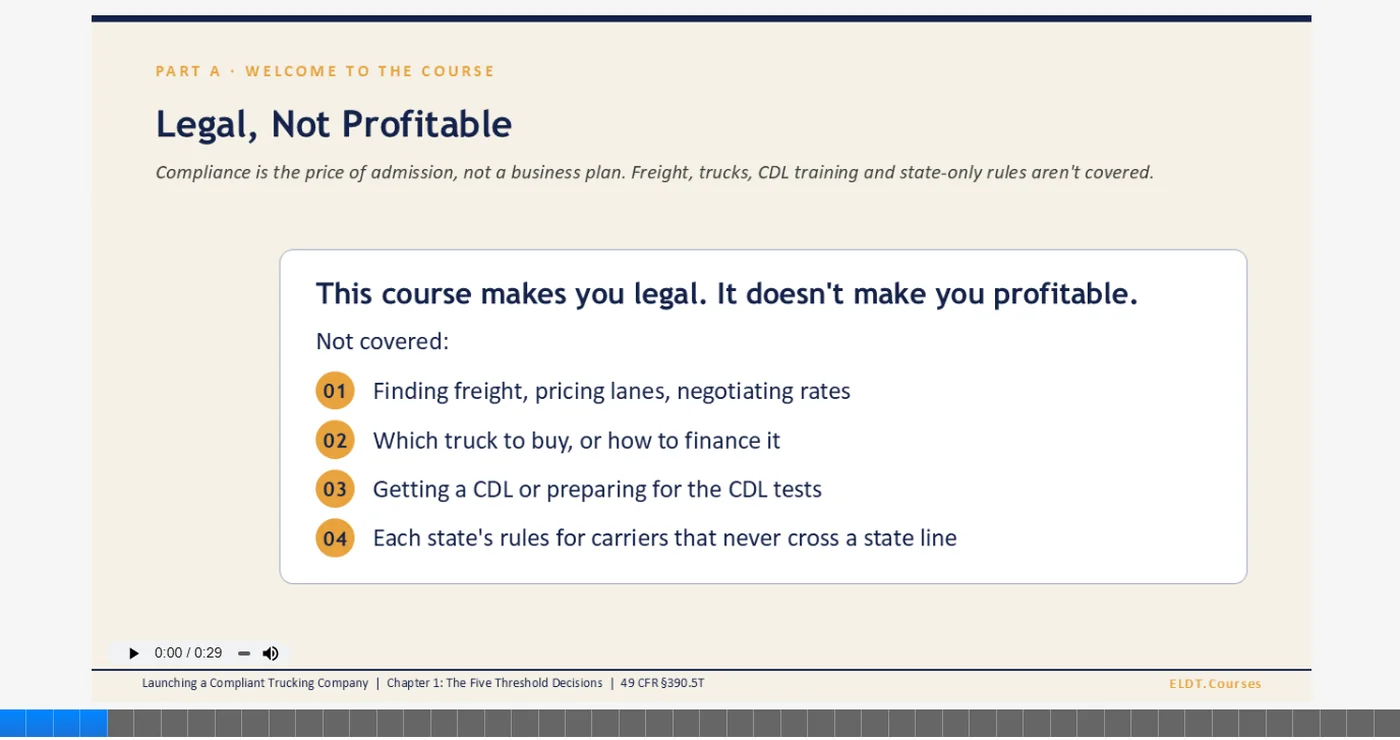
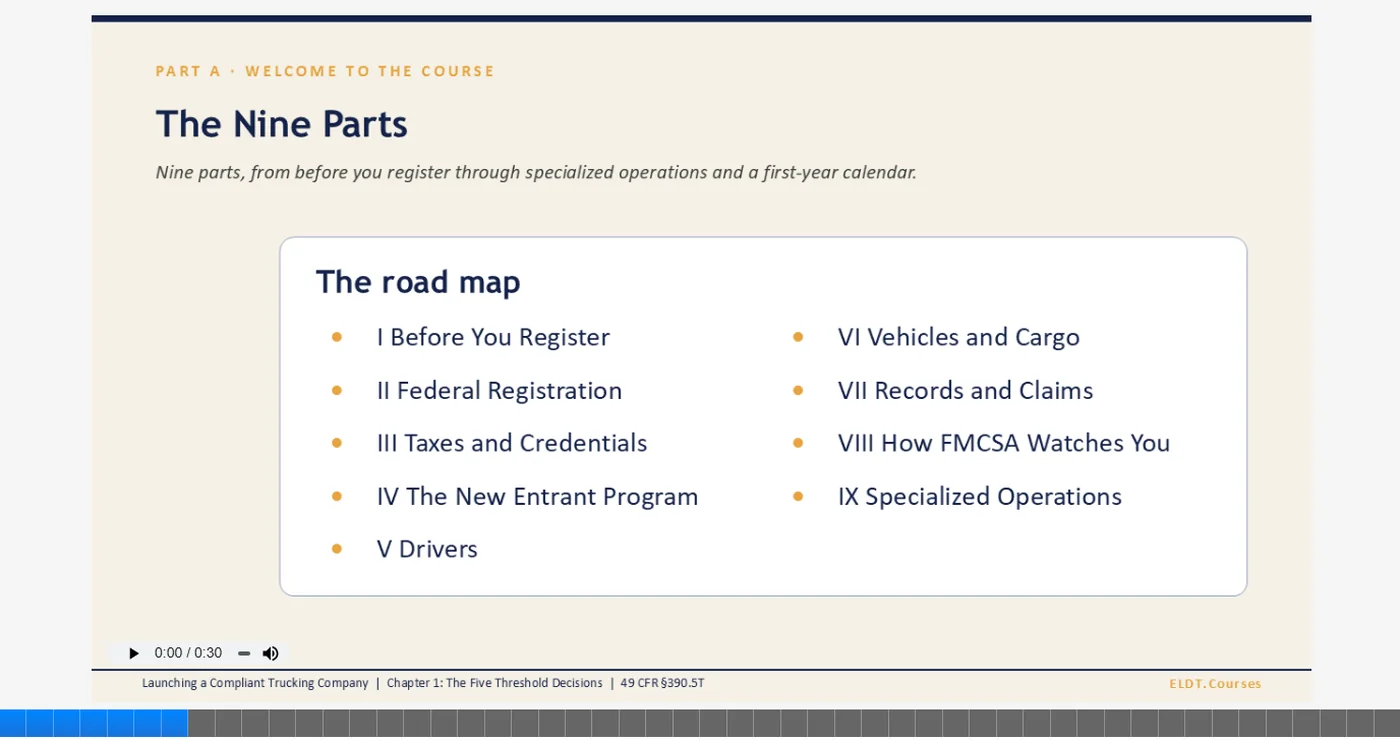
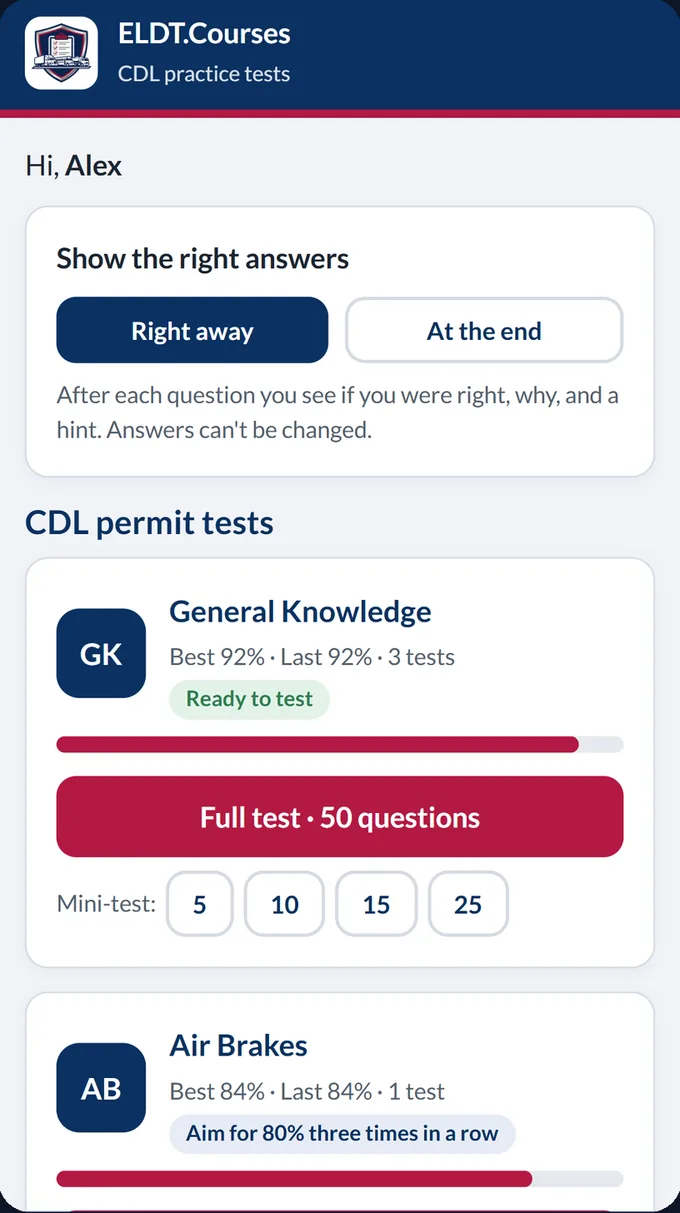
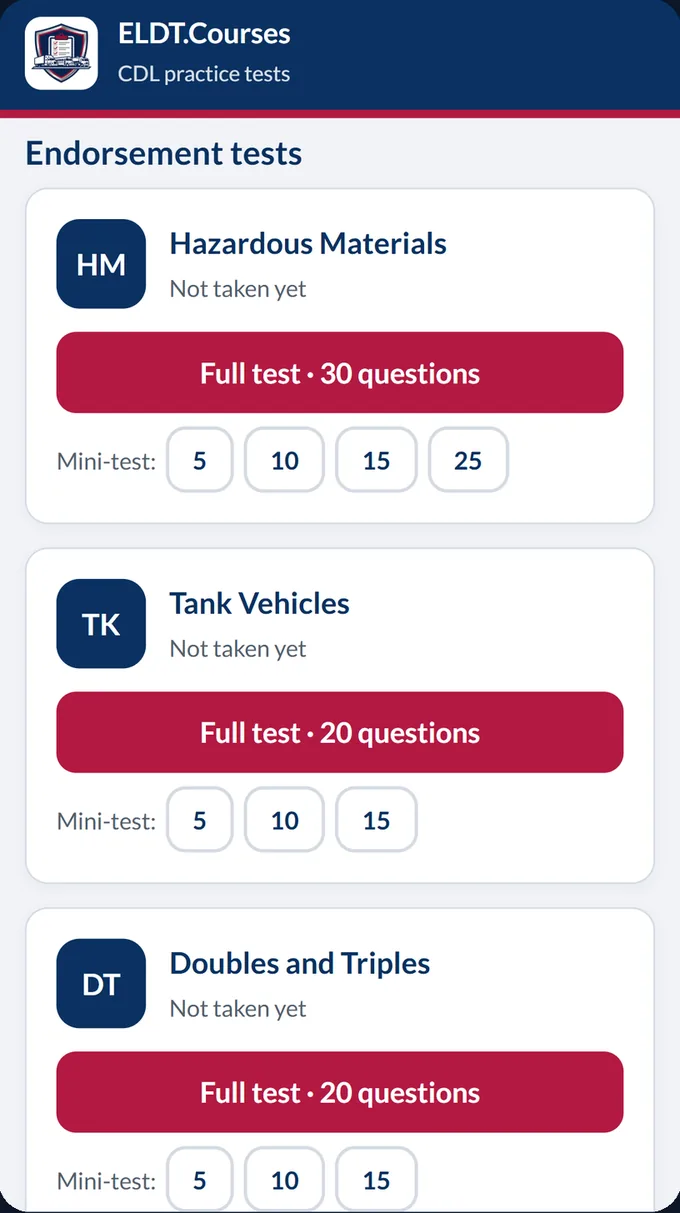
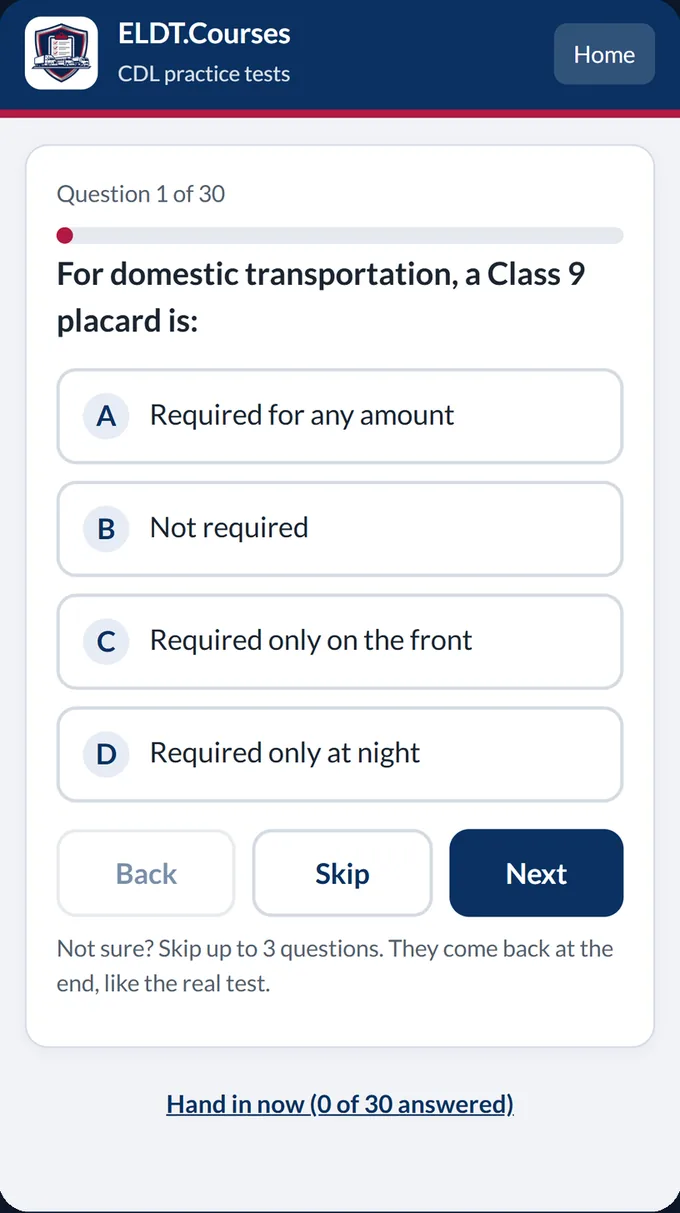
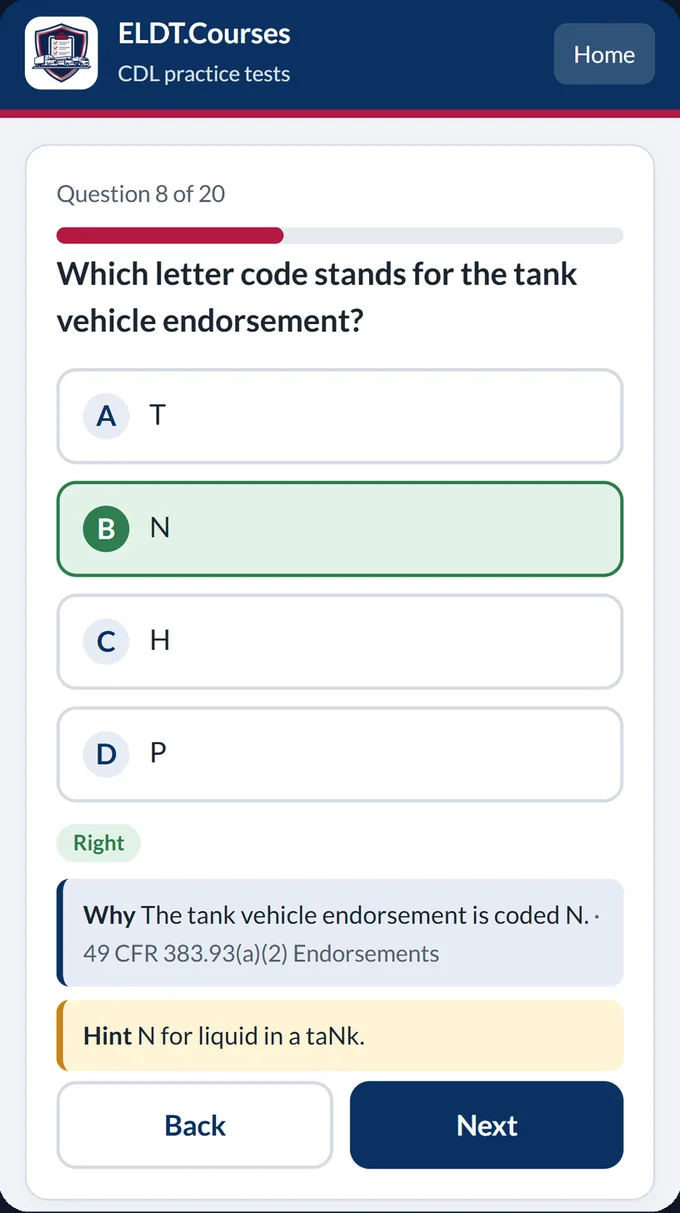
Real screens from Chapter 1 of this course, and the free practice app explaining each answer with the rule behind it. Everything works on a phone, a tablet or a computer, and you pick up where you left off.
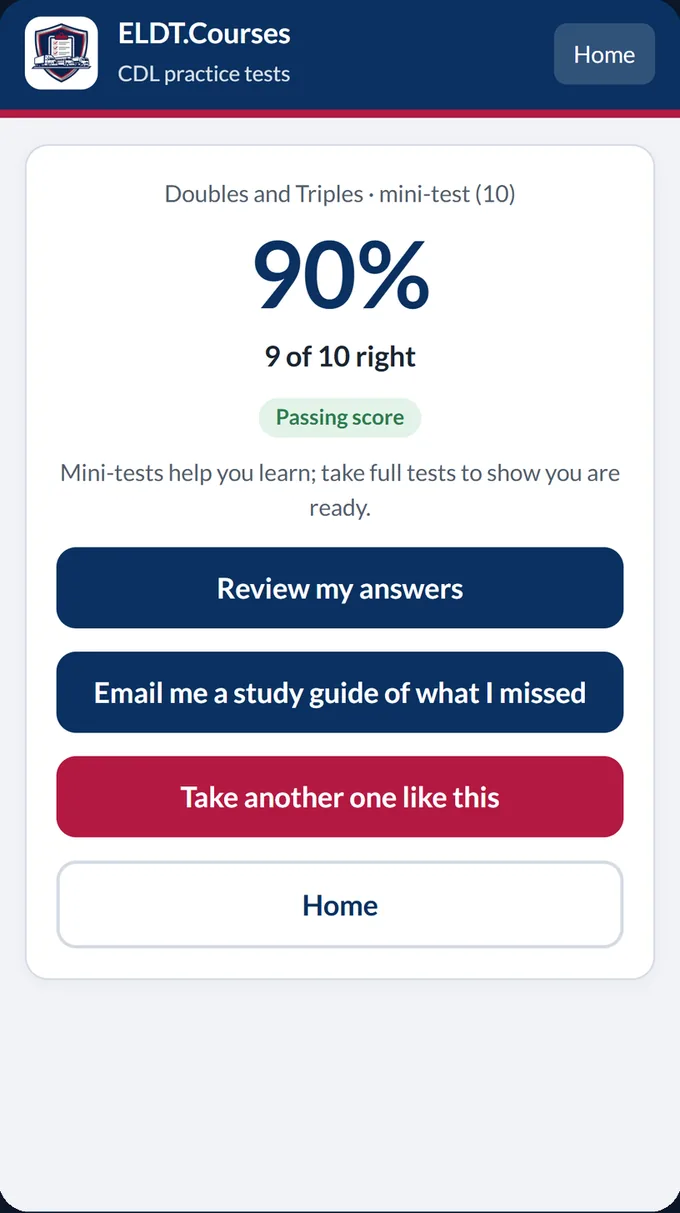
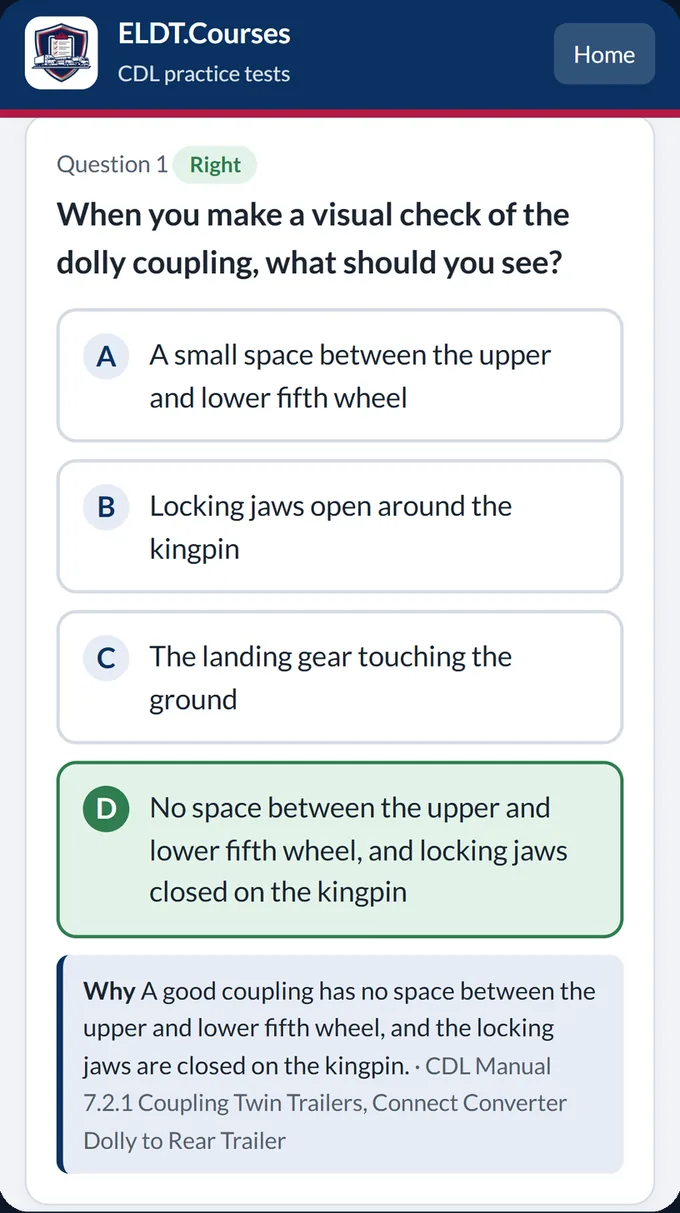
ELDT.Courses is listed on FMCSA's Training Provider Registry as an online theory provider. Search the registry for ELDT.Courses and you will find us, phone number and all: tpr.fmcsa.dot.gov/Search.
Every ELDT completion we report lands on your own driver record there by midnight of the second business day (49 CFR 380.717), so your state can see it before you test.
Anyone starting a trucking company — and the people who keep one compliant.
You're getting your own authority and want every federal step in the order you'll take it, from forming the business to your first year on the road.
You're adding trucks and drivers, or leasing on owner-operators. The course shows what changes when you become responsible for other drivers and their equipment.
You handle a carrier's compliance: driver files, drug and alcohol testing, logs, maintenance records and the filing calendar. The course gives you the rule behind each one.
Each chapter is a narrated lesson followed by a chapter test. Built on the federal regulations in 49 CFR and FMCSA's registration requirements, with the regulation behind every rule, and updated as rules and regulations change.
Interstate or intrastate, for-hire or private, what you haul, and how heavy your equipment is — the choices that decide which rules apply to you.
Sole proprietorship, LLC or corporation, your Employer Identification Number, and keeping your legal name and address identical on every filing.
Registering in Motus, FMCSA's registration system: identity and business verification, your USDOT number, and applying for operating authority.
What a process agent is, how the blanket BOC-3 filing works, and keeping your designation current.
The federal minimums for public liability, the MCS-90 endorsement, the filings your insurer makes with FMCSA, and what happens when coverage is cancelled.
From application to active authority, checking your status, the biennial update, and keeping your registration information current.
The scams aimed at new carriers, securing your FMCSA account, why you can't sell or rent your number, and how to report identity theft.
What UCR is, who has to register, how the fee brackets work, and renewing every year.
When the International Registration Plan applies, your base jurisdiction, cab cards, and the mileage records you have to keep.
Who needs an IFTA license, the quarterly return, your decals, and the records behind every return.
Which vehicles owe the federal heavy vehicle use tax, when Form 2290 is due, and the proof of payment you need to register.
How the New Entrant program works, what the auditor reviews, the violations that cause an automatic failure, and the corrective action plan.
Who needs a driver qualification file, what goes in it, the safety performance history investigation, and medical certification.
CDL classes and endorsements, Entry-Level Driver Training, the English proficiency requirement, and non-domiciled CDLs.
The federal leasing rules in 49 CFR Part 376: what a written lease must contain, who is responsible for the truck, and how leased equipment is marked.
Who 49 CFR Part 382 covers, the required tests, random testing pools, consortiums, and your Drug and Alcohol Clearinghouse duties.
Your written drug and alcohol policy, supervisor training, reasonable suspicion testing, and the rules against coercing or harassing drivers.
The driving and on-duty limits, when an electronic logging device is required, the short-haul exceptions, and the records you keep.
The 49 CFR Part 392 duties that land on the carrier: ill or fatigued drivers, texting and hand-held phone bans, and emergency equipment.
Systematic maintenance, driver vehicle inspection reports, the periodic inspection, inspector qualifications, and the records that prove it.
The 49 CFR Part 393 equipment basics, the general cargo securement rules, and the commodity-specific rules.
How your truck must be marked, the roadside inspection levels, out-of-service orders, and certifying repairs afterward.
What counts as a recordable accident, what the register must show, and how long you keep it.
Where your records can be kept, electronic records and signatures, how quickly you must produce them, and a master retention table.
What a bill of lading must contain, and the federal rules for acknowledging, investigating and resolving a freight claim.
How FMCSA scores carriers, the seven BASICs, what the percentiles mean for a new carrier, and challenging bad data through DataQs.
How a compliance investigation works, the three safety ratings, what follows a proposed rating, and how to ask for an upgrade.
Notices of claim and your options for responding, civil penalties, what happens when a penalty goes unpaid, and out-of-service orders.
What changes when you haul hazardous materials: registration, higher insurance minimums, and the safety permit for certain loads.
Passenger carrier authority, insurance levels by seating capacity, and the exemptions that apply to some operations.
Broker registration, the financial security requirement, and keeping your brokerage and carrier operations separate.
Every deadline from the course in one calendar, plus a dated list of proposed rule changes to watch.
32 narrated chapters with a test after each one. Self-paced, lifetime access, direct instructor support.
Enroll Now — $39 →Narrated lessons you can pause, replay and take at your own pace.
Every federal step from the decisions you make before you register to the end of your first year, in the order you'll take it.
80% to pass, unlimited retakes.
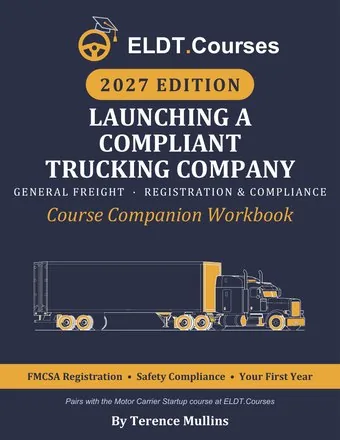
A 259-page workbook, included as a PDF download inside the course at no extra charge.
Pass all 32 chapter tests and your certificate is emailed to you automatically.
Courses are updated as rules and regulations change — and enrolled students get the updates at no charge.
Stuck on a filing or a form? Email me. Your access doesn't expire, so come back to the calendar chapter when your renewals come due.

I spent 10 years as an OTR driver and about 10 more in dispatch and driver recruiting before founding ELDT.Courses. This course explains what each requirement for a new motor carrier is, why it exists, and when in your startup it has to happen.
Every chapter is built on primary sources — the federal regulations in 49 CFR and FMCSA's own registration requirements. Where the rules differ from state to state, the course tells you so and points you to your own state.

I've been around commercial trucking long enough to know what the standard endorsement course looks like — a recycled DMV manual, slow narration, and a quiz at the end. Drivers deserve better.
ELDT.Courses is what I wish I'd had when I was studying. Every chapter explains the why, not just the rule. Every quiz pulls from real test material. Every minute is paid for in attention, so I made sure none of them are wasted.
Have a question before you enroll? Pick a time and I will call you. Book a free phone call.
No. This is a business and regulatory course for people starting a trucking company. It is not Entry-Level Driver Training (ELDT), and nothing is submitted to the Training Provider Registry.
New owner-operators getting their own authority, small fleet owners, and the office managers, dispatchers and safety staff who handle compliance for a new motor carrier.
The course teaches the federal requirements. Rules for registration, taxes and in-state operations vary from state to state, so the course tells you where they differ and to check with your own state.
No. The federal rules apply to a one-truck carrier too. The course walks through each requirement in the order you meet it, and points out the places where the rules treat a single-truck or single-driver operation differently.
Yes. A 259-page Course Companion Workbook is included as a PDF download inside the course at no extra charge.
Yes. When you pass all 32 chapter tests, a certificate of completion is emailed to you automatically.
No. This course is for education only. It is not legal, tax or insurance advice, and FMCSA systems and fees change, so always confirm on FMCSA's website before you file.
Each of the 32 chapters ends with a test. You need 80% to pass, and you can retake any chapter test as many times as you need.
Try it risk-free. If you enroll and decide within 7 days that it's not for you — and you haven't started the course content — just email me and I'll refund you, no questions asked. Once you begin working through the material, the course is yours for life, including all future updates. Full terms are in our Terms of Service.
32 chapters. Built on the federal regulations. Lifetime access. Real instructor support.
Enroll Now — $39 →Questions before you enroll? Email terry@eldt.courses or call 1-814-304-7635.