
A 12-chapter ELDT theory course built to FMCSA Appendix F. Every required topic covered — loading and unloading procedures, railroad-highway grade crossings, emergency exits, student management, and the regulations that govern every mile a school bus driver operates. When you finish, we submit your completion to the Training Provider Registry within two business days so you can sit for the state knowledge test.
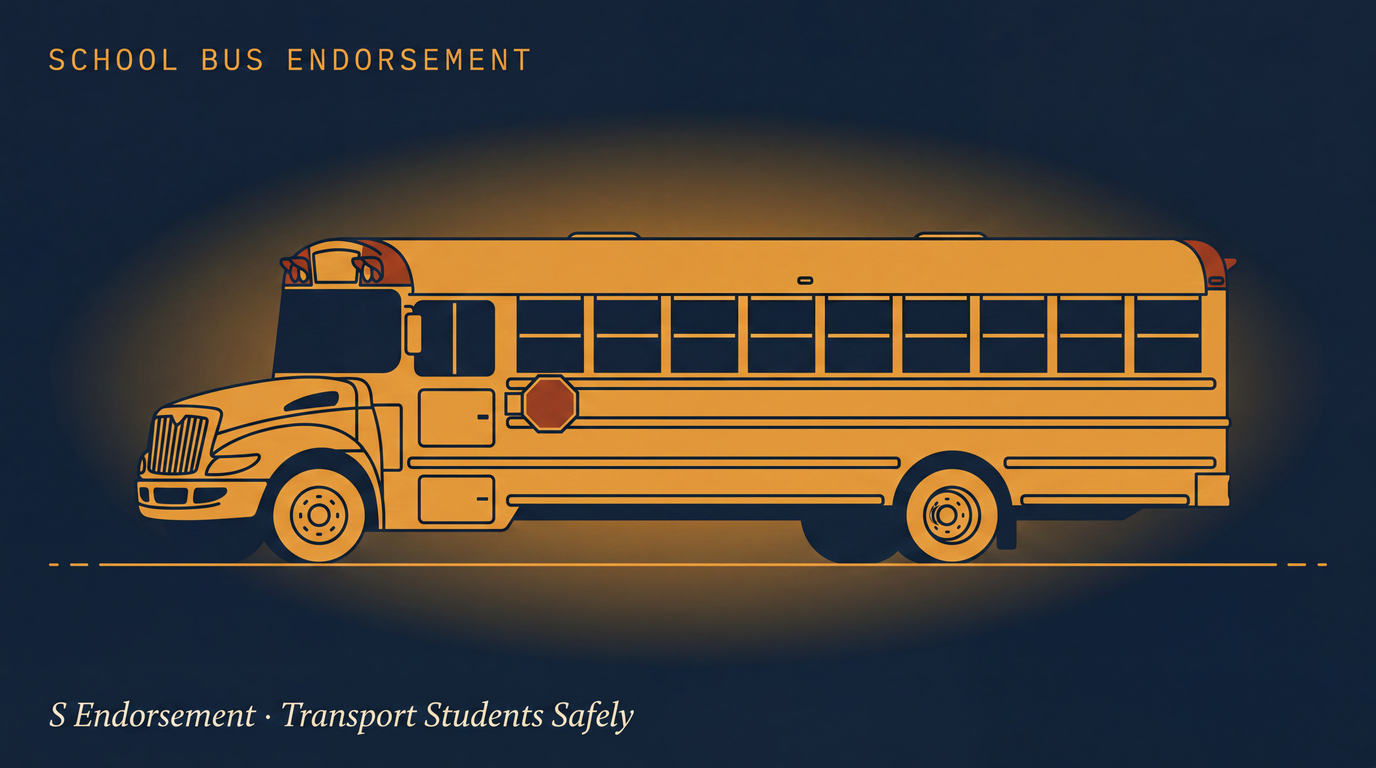
The S endorsement is one of the most responsibility-intensive endorsements a CDL driver can hold. Whether you're new to school bus operation or adding the endorsement to an existing CDL, this course gets you federally compliant and genuinely prepared.
You've been hired by a school district or transportation contractor and you need your S endorsement before you can operate a route. The district needs your ELDT theory documented. This is that documentation — built to the federal standard and submitted to the TPR within two business days of your completion.
You already have a CDL and you're adding the S endorsement to open up school bus work alongside your existing driving career. Steady hours, consistent routes, and benefits that OTR work rarely offers. This course gets the endorsement requirement handled quickly.
You've been driving a school bus under an employer exemption or a grandfather arrangement. ELDT requirements have tightened, and your district or state is asking for documented theory training. This course closes that gap with a federally registered Training Provider record.
This is theory training built directly on primary sources: 49 CFR Part 380 Appendix F, 49 CFR Part 392, and FMCSA's school bus-specific operating regulations. Every chapter explains the rule and the reason behind it.
What ELDT is, why it exists, and how the S endorsement training requirement fits into 49 CFR Part 380. The Training Provider Registry, how your completion gets reported, and what happens next after you finish the course.
Types of school buses and their federal classifications, the unique legal responsibilities of a school bus driver versus other CDL holders, state vs. federal jurisdiction in school bus regulation, and the professional standard the S endorsement represents.
The complete pre-trip inspection procedure specific to school buses: engine compartment, body and exterior, mirrors and mirror adjustment, emergency exits and their operation, lighting systems, the crossing control arm, and the interior student area — what to check and what to report before a single student boards.
The complete loading and unloading sequence, danger zones and the 10-foot perimeter rule, proper use of mirrors to account for blind spots, student escort procedures, and how to handle a student who fails to clear the danger zone before you move the bus. The procedure that prevents the accidents that make national news.
Seating assignments and student accountability, managing disruptive behavior without compromising vehicle control, communication with students and with dispatch, and the driver's legal authority and responsibility for student safety from the moment students board to the moment they are safely away from the bus.
Requirements for transporting students with disabilities, wheelchair securement systems and tie-down procedures, communication with students who have special needs, IEP transportation provisions, and the additional care responsibilities that apply on special needs routes.
The mandatory stopping requirement at all railroad-highway grade crossings under 49 CFR 392.10 — when to stop, where to stop (15–50 feet from the nearest rail), and how to proceed safely. The statutory exceptions under 49 CFR 392.10(b), including the 2025 exception for certain exempt crossings. What the law requires, what it permits, and why the distinction matters for every school bus driver who operates a route with a crossing.
Location and operation of all emergency exits: rear door, roof hatches, side emergency doors, and push-out windows. The complete evacuation sequence, student roles and assignments, evacuation drills and their frequency requirements, and post-evacuation accountability — how to know every student is off the bus and clear of danger.
Speed management with a bus full of students, following distance, mirror usage while moving, safe stopping distances compared to personal vehicles, backing procedures and when to avoid backing entirely, and how adverse weather changes every calculation a school bus driver makes about speed, spacing, and stopping.
On-road emergencies: vehicle fires, brake failure, stuck accelerator, and medical emergencies involving students. Post-accident procedures, reporting requirements, securing the scene, student accountability after an incident, and the communication chain from driver to dispatch to parents to authorities.
The post-trip inspection walkthrough, the mandatory student sweep after every route — checking every seat, floor, and overhead rack for sleeping or hiding students — DVIR completion, and the legal and moral weight of a missed student check. The procedure that prevents a child from being left on a hot bus.
Scenario-based review of the high-weight topics the state School Bus knowledge test targets — loading sequences, railroad crossing rules, emergency exit procedures, and the numbers the test consistently asks about. Common testing traps, a critical-rules reference sheet, and your final compliance acknowledgment before TPR submission.
12 chapters built to FMCSA Appendix F. Self-paced, no minimum hours, TPR submitted within two business days of completion.
Enroll Now — $95 →The S endorsement carries more real-world responsibility than almost any other CDL credential. Here's how this course measures up.
| Typical online course | ELDT.Courses | |
|---|---|---|
| Course content | Auto-play video, auto-advance quizzes | Narrated chapters, must complete each topic |
| Built from | Secondhand training summaries | Primary sources: 49 CFR 380 Appendix F & 392 |
| Quiz standard | Varies — often no defined threshold | FMCSA standard: 80%, unlimited retakes |
| Instructor access | None, or a ticket queue | Direct email to the author, usually within 24 hrs |
| TPR submission | Timing varies, sometimes delayed | Within 2 business days of your completion |
| Regulatory currency | May not reflect 2025 regulatory updates | Includes 2025 railroad crossing exception update |
| Price | $50–$150 for comparable content | $95 — complete Appendix F coverage |
Every Appendix F topic covered, built for genuine understanding — not just checkbox compliance. Self-paced, no minimum hours. Finish in a day or take a week.
Within two business days of your completion, we submit your record to the FMCSA Training Provider Registry. Your state DMV can then verify your ELDT compliance and clear you for the S endorsement knowledge test.
Each module ends with a quiz built from the same style of questions the state knowledge test uses. 80% passing threshold, unlimited retakes. The loading sequence and railroad crossing rules won't be a surprise on test day.
Loading and unloading procedure cards, danger zone diagrams, emergency evacuation sequence reference, railroad crossing rules quick-sheet, and post-trip student check checklist — formatted for the dash clip and the driver's manual pocket.
Questions about a chapter, a regulation, or a situation your district hasn't covered in orientation? Email terry@eldt.courses directly. A working trucking instructor who knows the federal regs answers — not a ticket queue.
Your access doesn't expire. Review the evacuation sequence the night before your first drill. Come back to the railroad crossing chapter any time you want it fresh. The course updates when the regulations update.

The S endorsement is not an endorsement to take lightly. The loading and unloading sequence, the railroad crossing stop requirement, the post-trip student check — these aren't bureaucratic boxes. They exist because children have been killed when drivers got these procedures wrong. This course treats them with the weight they deserve.
Every chapter is built on the primary federal source material: 49 CFR Part 380 Appendix F, 49 CFR Part 392, and the specific school bus operating regulations that govern what a driver must do, may do, and is prohibited from doing. The explanations go deeper than the regulation requires because understanding why a rule exists is what makes a driver follow it correctly when the situation gets complicated.
If you're going to hold an S endorsement, you should understand every procedure in this course — not just well enough to pass a test, but well enough to execute it under pressure with a bus full of kids behind you.
Most students finish in 6–10 hours of focused work, often spread over 2–3 sittings. There is no minimum hour requirement — FMCSA requires 100% topic completion, not a fixed number of seat hours. Work at whatever pace fits your schedule.
Yes. ELDT.Courses is a registered Training Provider in the FMCSA Training Provider Registry. This course is built to 49 CFR Part 380, Appendix F — the federal specification for School Bus ELDT theory training. Completing this course satisfies the federal theory training requirement for the S endorsement.
As soon as your completion is submitted to the FMCSA Training Provider Registry and your state DMV can verify it. We submit completions every business day, Monday through Friday — so in most cases your record is in the TPR the same day or the next business day after you finish. Once it's in the TPR, you're cleared to schedule the S endorsement knowledge test with your state.
No. The S endorsement ELDT requirement is theory-only at the federal level. After your completion is submitted to the TPR and you pass the state knowledge test, your employer or state may require additional behind-the-wheel training before you operate a route independently — but that is separate from the federal ELDT theory requirement this course fulfills.
No — but you will need a valid CDL before your state will issue the S endorsement. Many drivers take this course alongside their CDL training or immediately after receiving their CDL. If you already have a CDL and are adding the endorsement, you're ready to enroll now.
Under federal law (49 CFR 392.10), yes — with narrow exceptions. A school bus must stop between 15 and 50 feet from the nearest rail, look and listen in both directions, and proceed only when safe. The 2025 regulatory update added an exception for certain crossings specifically designated as exempt by the relevant state authority. The course covers both the rule and the exceptions in full, because knowing when the exception applies is as important as knowing the rule itself.
80%, consistent with the FMCSA standard. Unlimited retakes on any quiz. The goal is that you actually understand the material — especially the loading sequence and emergency procedures — not just that you passed on a first attempt.
Yes. The course runs in your browser on any device — phone, tablet, laptop, or desktop. No app to install. Many drivers complete a significant portion of the coursework on their phone during downtime between shifts.
Try it risk-free. If you enroll and decide within 7 days that it's not for you — and you haven't started the course content — just email me and I'll refund you, no questions asked. Once you begin working through the modules, the course is yours for life, including all future updates. The one hard exception: if your completion has already been submitted to the TPR, that federal record exists and the refund window closes at that point. Full terms are in our Terms of Service.
Yes. terry@eldt.courses goes directly to me. Questions about the course content, a specific regulation, what your district requires, or anything else about the S endorsement — I'll get back to you, usually within 24 hours.
12 chapters. Built to FMCSA Appendix F. Every procedure explained, not just listed. Submitted to the TPR within two business days. Lifetime access. Real instructor support.
The kids on your route deserve a driver who knows this material cold. This course gets you there.
Onboarding multiple drivers for your district or transportation contract? Fleet and district inquiries welcome — email terry@eldt.courses or call 1-814-304-7635.