
Thirty single-topic refreshers and five series for drivers who already hold the license. Each lesson is narrated, built on the federal rules with the source on each rule slide, and ends with a 10-question test and a certificate. Not ELDT; nothing is reported to the Training Provider Registry.
Each series puts related lessons in one course, with a test after each lesson and one certificate when you pass them all. $20 per series.
Ten defensive driving lessons, from visual search to railroad crossings.
Pre-trip, malfunction diagnosis, roadside inspections and maintenance in four lessons.
The hours-of-service rules and the science of staying alert, in two lessons.
Post-crash procedures, communicating with officers, coercion protections and trip planning.
Drug and alcohol testing and medical qualification, in two lessons.
One narrated lesson, a 10-question test and a certificate when you pass. Listed in the order a driver learns them. $10 per course.
The federal rulebook, the anatomy of a combination vehicle, and the weight rules, including the Federal Bridge Formula.
Controls, mirrors, seat belts, gauges and warning lights, explained one at a time.
The seven-step pre-trip, air brake system and tests, en route checks and the post-trip report.
Starting, stopping, turning, centering, merging and tight-space maneuvering in a combination vehicle.
Transmission types, the automatic-transmission restriction, clutch use, double-clutching and engine braking.
GOAL, set-up, spotters, the five backing maneuvers and docking, each in its own step.
Coupling, the tug test, uncoupling and sliding the fifth wheel, one step at a time.
Scanning ahead and to the sides, mirror habits, no-zones and spotting distracted road users.
Signals, flashers, horn, headlights, eye contact and lane position as communication.
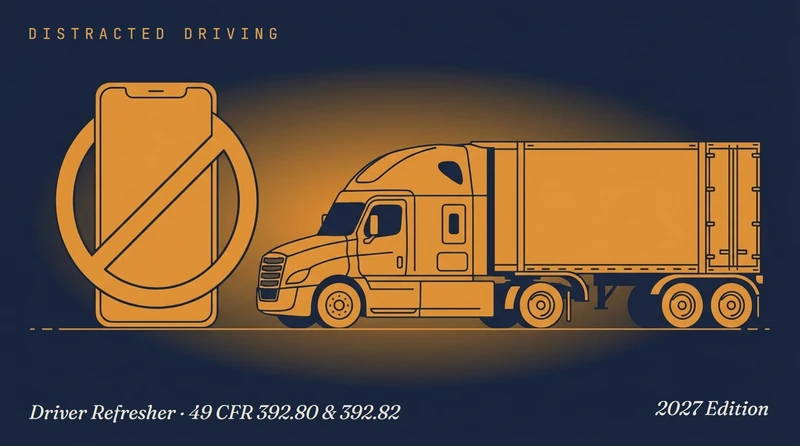
The federal texting and hand-held phone rules in 49 CFR 392.80 and 392.82, what they allow and what they don't, and what a violation costs.
Stopping distance, speed and weight, slippery roads, following distance, curves and downgrades, and the federal rules on schedules and hazardous conditions.
Following distance, space behind and beside you, and room for merging traffic.
Glare, headlights, speed and space adjustments, and hazards specific to driving at night.
Rain, fog, wind, heat, ice and snow, tire chains and mountain grades.
Reading developing hazards, work zones and high-risk locations.
Skid recovery, jackknifing, emergency braking, blowouts, brake failure and off-road recovery.
Who stops, who slows, the stop procedure, crossing signs and signals, and the penalties.
How the major vehicle systems work, how they fail, and when you must stop.
The roadside inspection process, driver and vehicle checks, and out-of-service orders.
The carrier's maintenance duty, annual inspection, and driver servicing checks.
Weight distribution, securement rules, inspection intervals, documents and seals.
Idling rules, spill response, waste handling and emissions-system integrity.

The 10-hour, 14-hour, 11-hour and 30-minute rules, the 60/70-hour limits and the sleeper berth split, taught from 49 CFR Part 395.
Acute and chronic fatigue, warning signs, sleep, health habits and a personal fatigue plan.
Scene protection, warning devices, emergency equipment, post-accident testing and records.
Talking with officers, dispatch and shippers, English proficiency, and your driving record.
Coercion, complaints to FMCSA, and the driver's legal right to refuse an unsafe operation.
Routes, clearances, permits, the legal clock, fuel, rest and weather.
Prohibited conduct, the testing triggers, return to duty and the Clearinghouse.
Driver qualification, physical standards, the medical exam and the certification cycle.
Built for fleets, carriers and training managers who set ongoing or continuing-education training for their drivers. Each course is online and self-paced, covers one topic at a time, and costs $10 a topic or $20 a series per driver. Every course ends with a test, and each driver who passes gets a certificate of completion with their name, the course and the date.
Each employer or agency decides whether a course counts toward its own training or continuing-education requirement. On its own, a course does not meet any federal or state requirement.
A short, standalone online course for drivers who already hold a CDL. Each one covers a single topic, built on the federal rules and the CDL driver's manual with the source on each rule slide, and ends with a test and a certificate.
No. This is a standalone refresher course. It is not entry-level driver training (ELDT), nothing is submitted to the Training Provider Registry for it, and it doesn't count toward a CDL or an endorsement.
Yes, if your company decides they fit. Each course is an online, self-paced refresher on one topic that ends with a test and a certificate of completion showing the driver's name, the course and the date. Your company or agency decides whether it counts toward its own training or continuing-education requirement; on its own, a course does not meet any federal or state requirement.
A single-topic course is one lesson and one test. A series puts several related lessons in one course with one enrollment, a test after each lesson, and one certificate when you pass them all. Every lesson in a series is also sold on its own.
$10 per single-topic course and $20 per series.
When you pass, a certificate of completion with your name, the course and the date is created automatically and emailed to the address you sign in with. It's a record of the training, not a license or a permit.
Try it risk-free. If you enroll and decide within 7 days that it's not for you — and you haven't started the course content — just email me and I'll refund you, no questions asked. Once you begin working through the material, the course is yours for life, including all future updates. Full terms are in our Terms of Service.