
A 15-chapter course for anyone designated to supervise DOT safety-sensitive employees. Recognize the signs of alcohol misuse and drug use, make a determination that holds up, document it, and know what happens after the test.
Take FMCSA Essentials: the orientation, the legal standard, and the alcohol and controlled substances chapters, with a final exam and certificate. Built to meet 49 CFR 382.603.
See FMCSA Essentials — $29 →Take the full 15-chapter course. It adds the FTA, FAA, FRA, PHMSA and Coast Guard rules, plus full chapters on the conversation, the written record, and return-to-duty.
You’re on this page ✓Every employer with DOT-covered employees has to train the people who make reasonable suspicion calls. That includes fleets, CDL schools, municipalities, waste haulers, school districts, transit agencies, and aviation, rail, pipeline and maritime employers.
Terminal managers, safety managers, dispatchers and lead drivers who are designated to supervise drivers under 49 CFR Part 382. This is the training 49 CFR 382.603 requires.
Municipal fleets, school districts, waste haulers and CDL schools that employ CDL drivers are covered by the same Part 382 testing rules as any motor carrier.
Your agency has its own supervisor training rule. Chapters 13 and 14 explain the FTA, FAA, FRA, PHMSA and Coast Guard requirements and how each differs from FMCSA's. Confirm the course fits your agency's rule before relying on it.
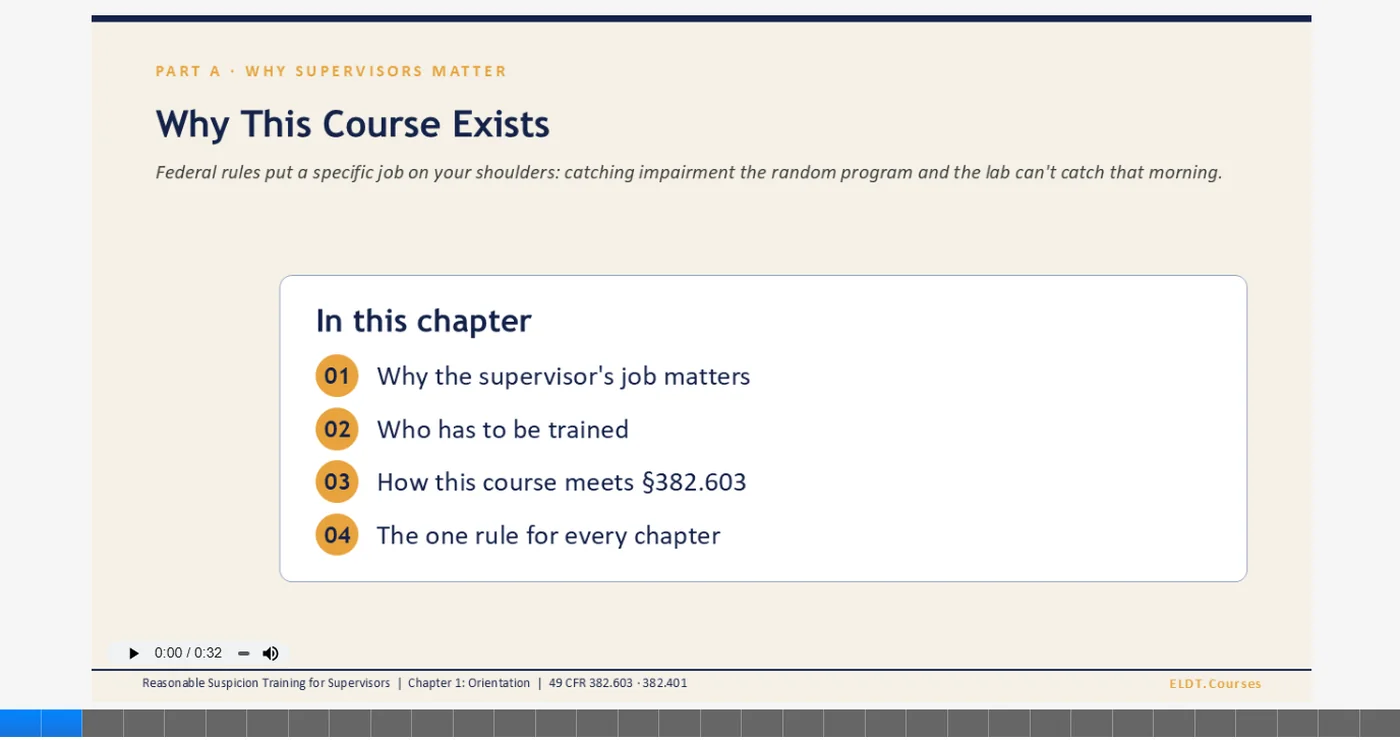
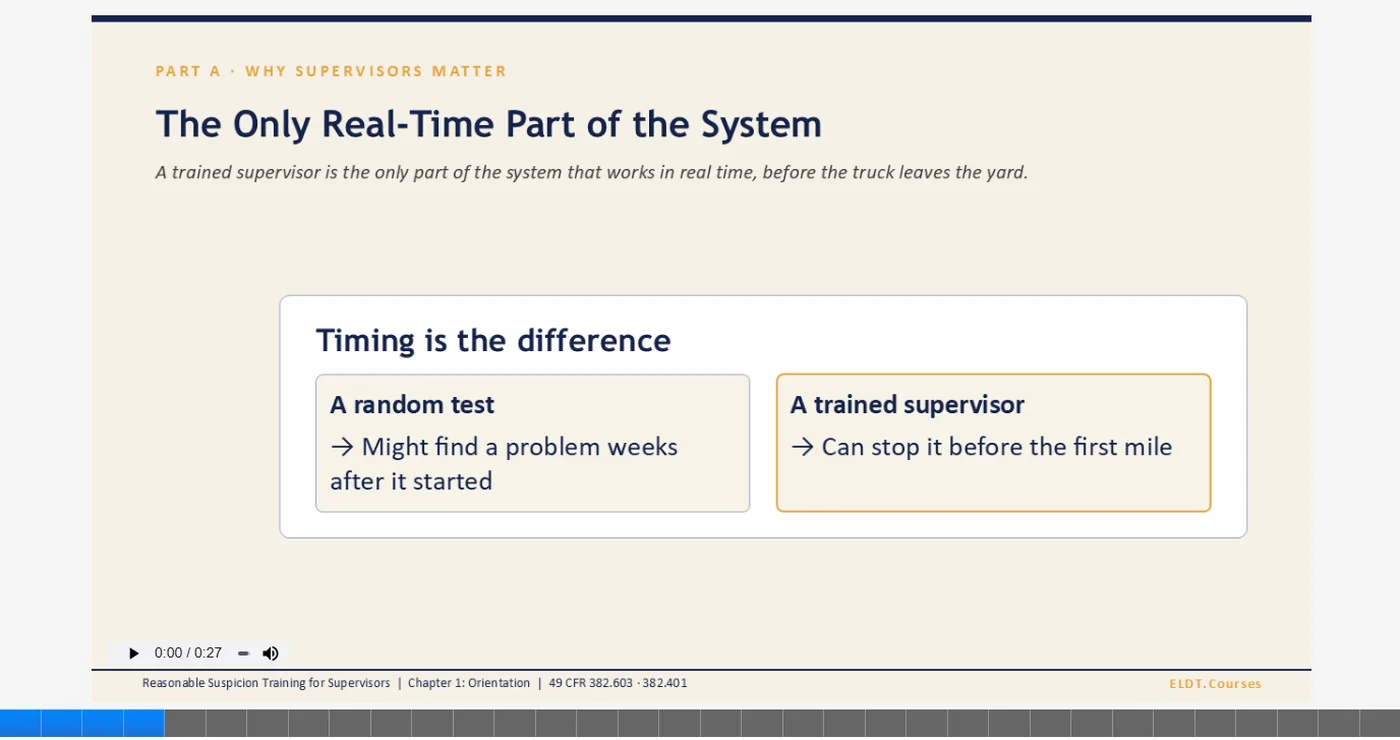
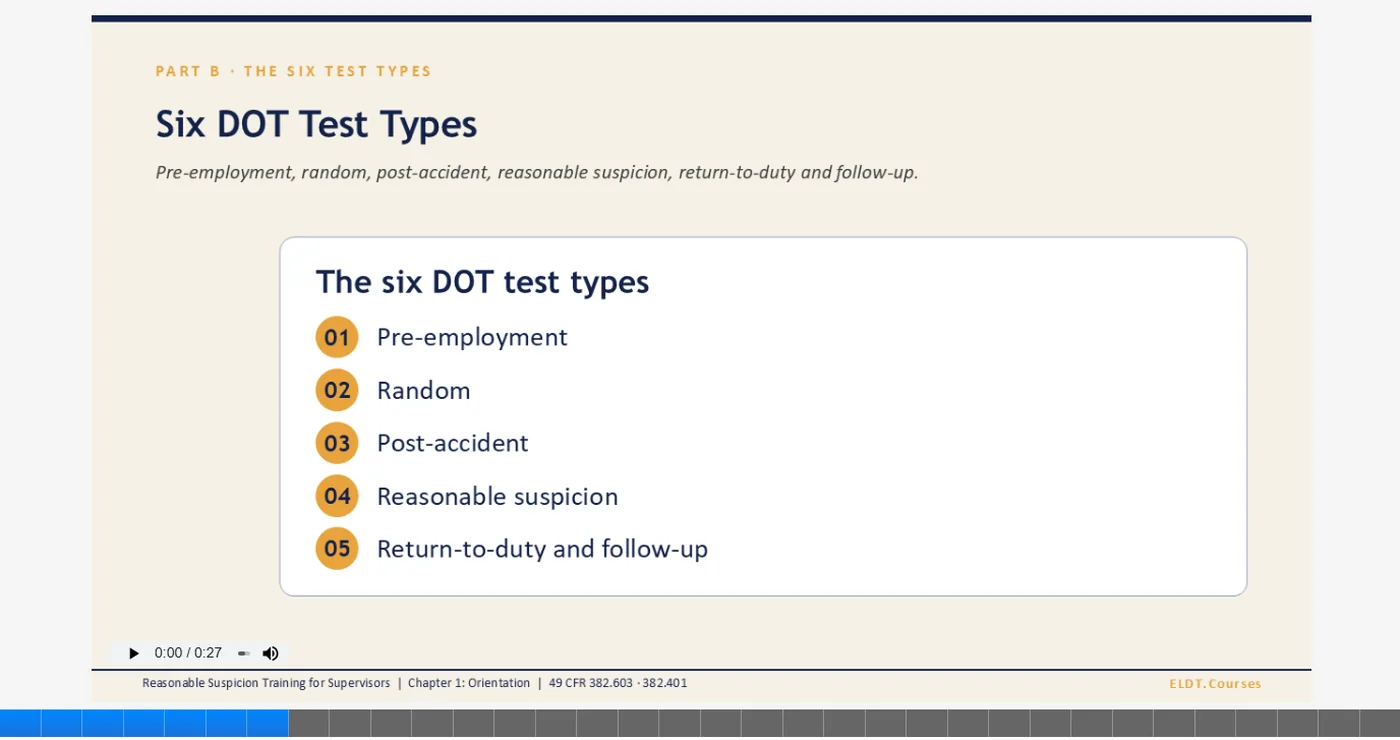
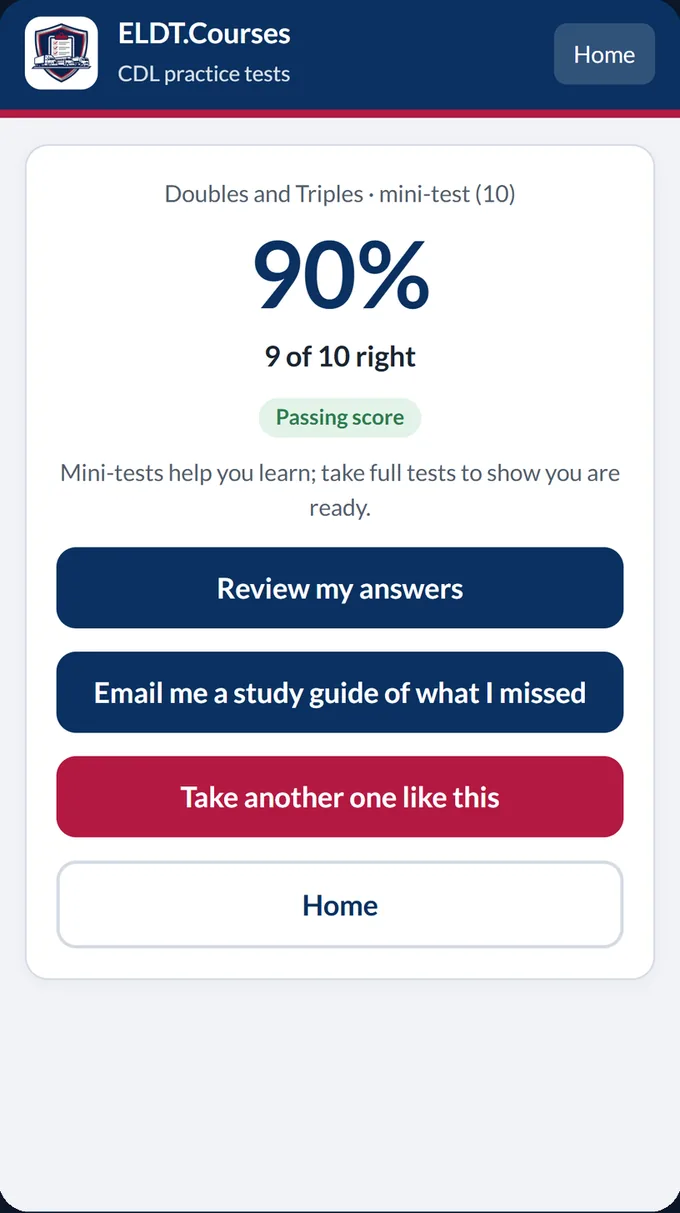
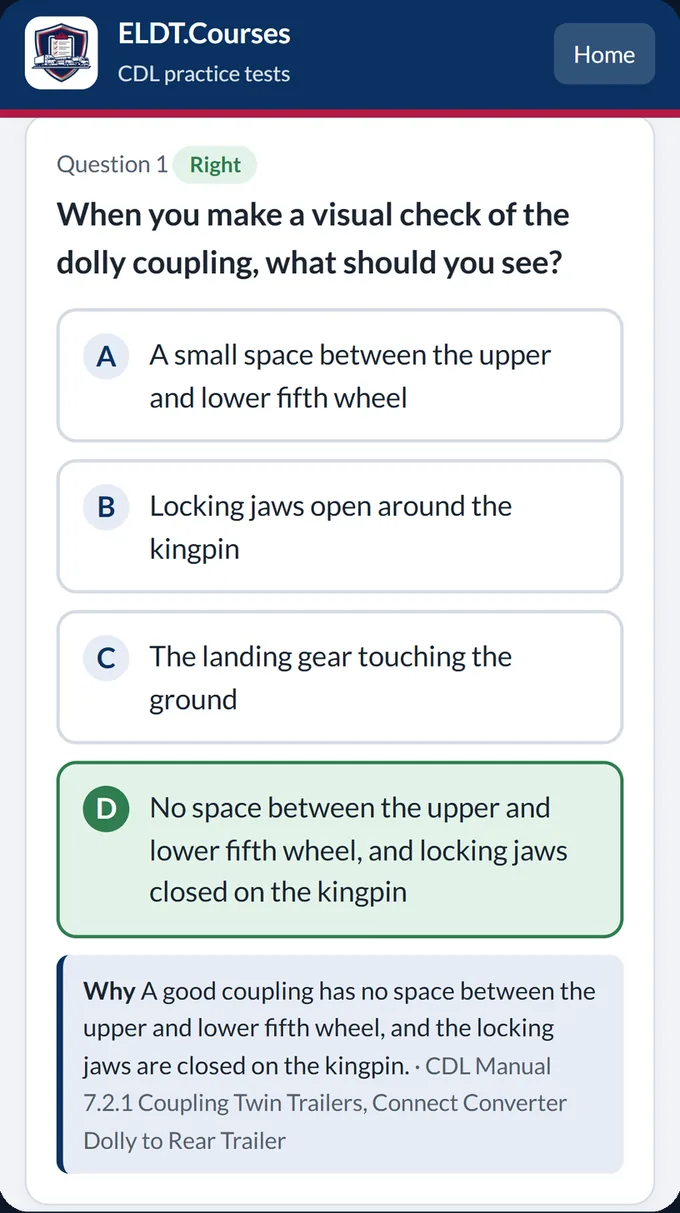
Real screens from Chapter 1 of this course, and the free practice app explaining each answer with the rule behind it. Everything works on a phone, a tablet or a computer, and you pick up where you left off.
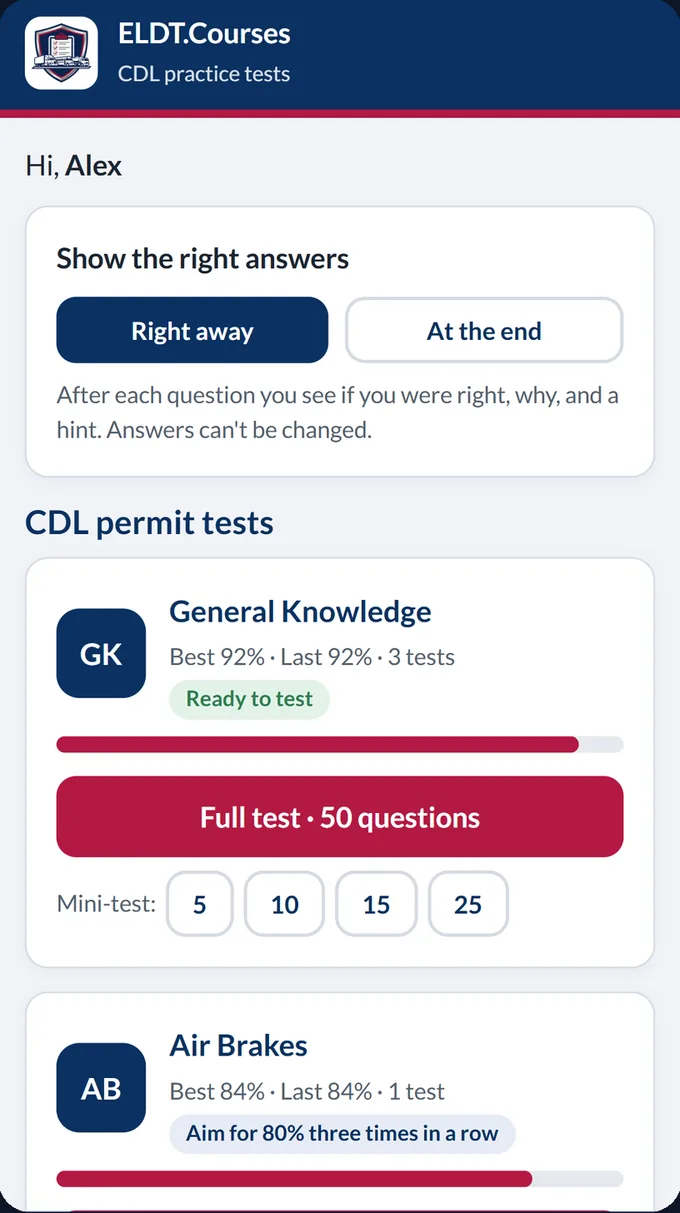
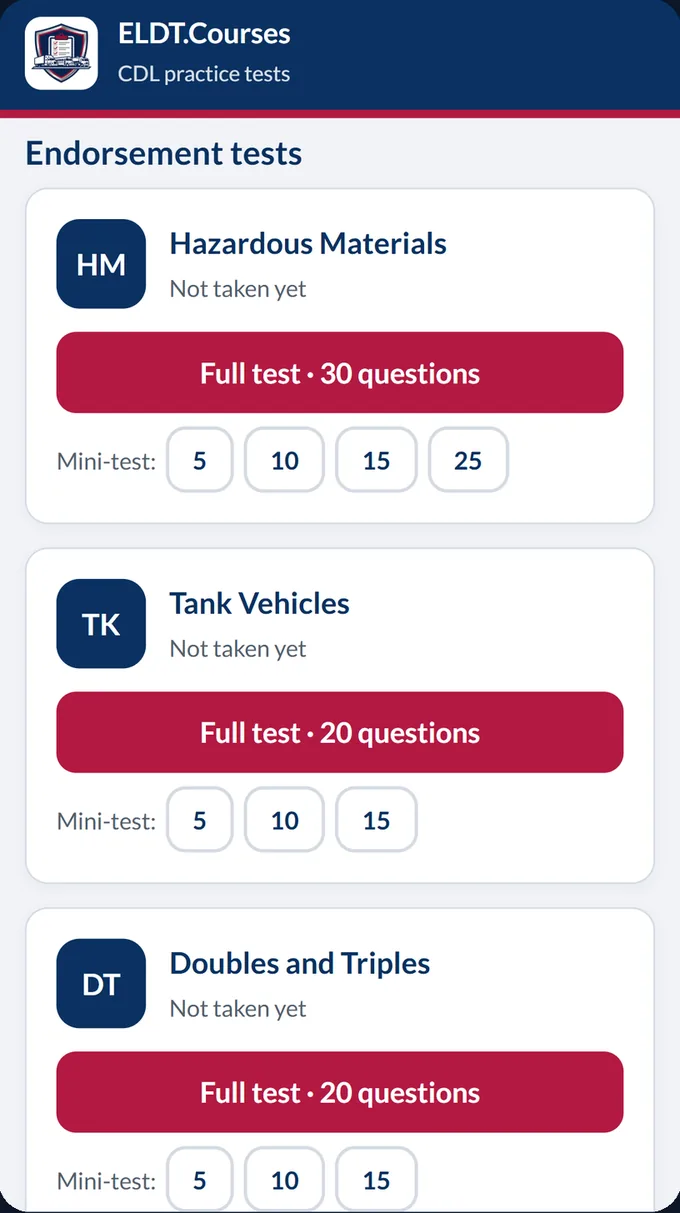
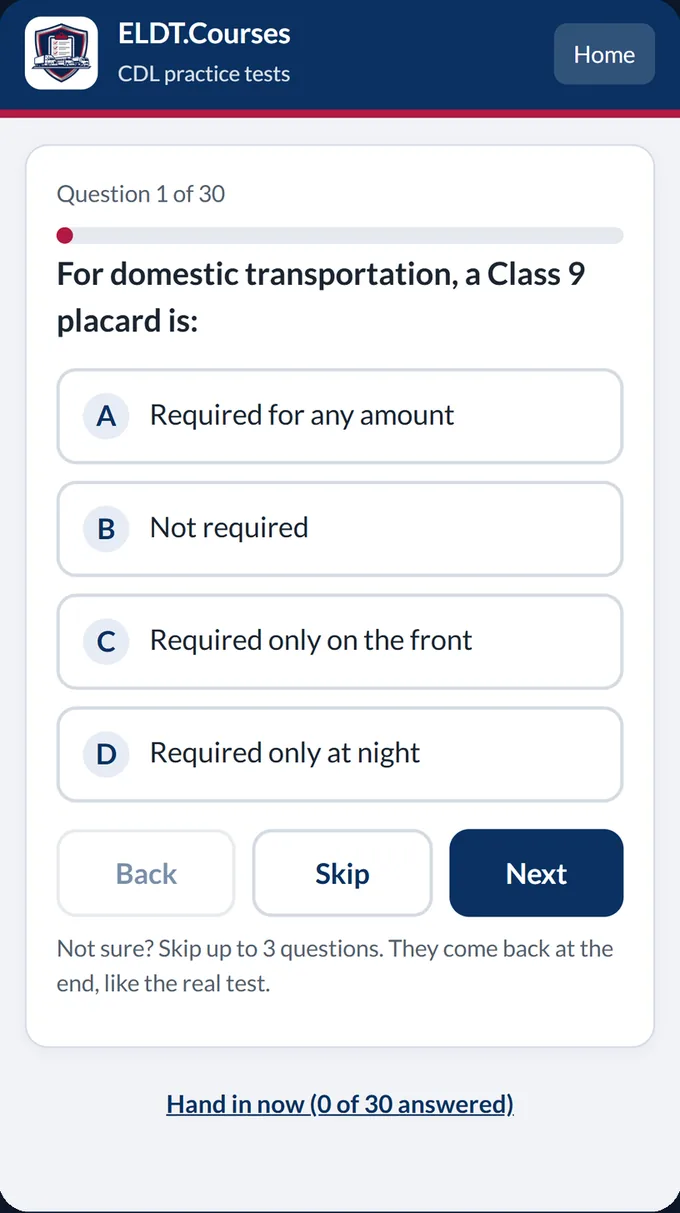
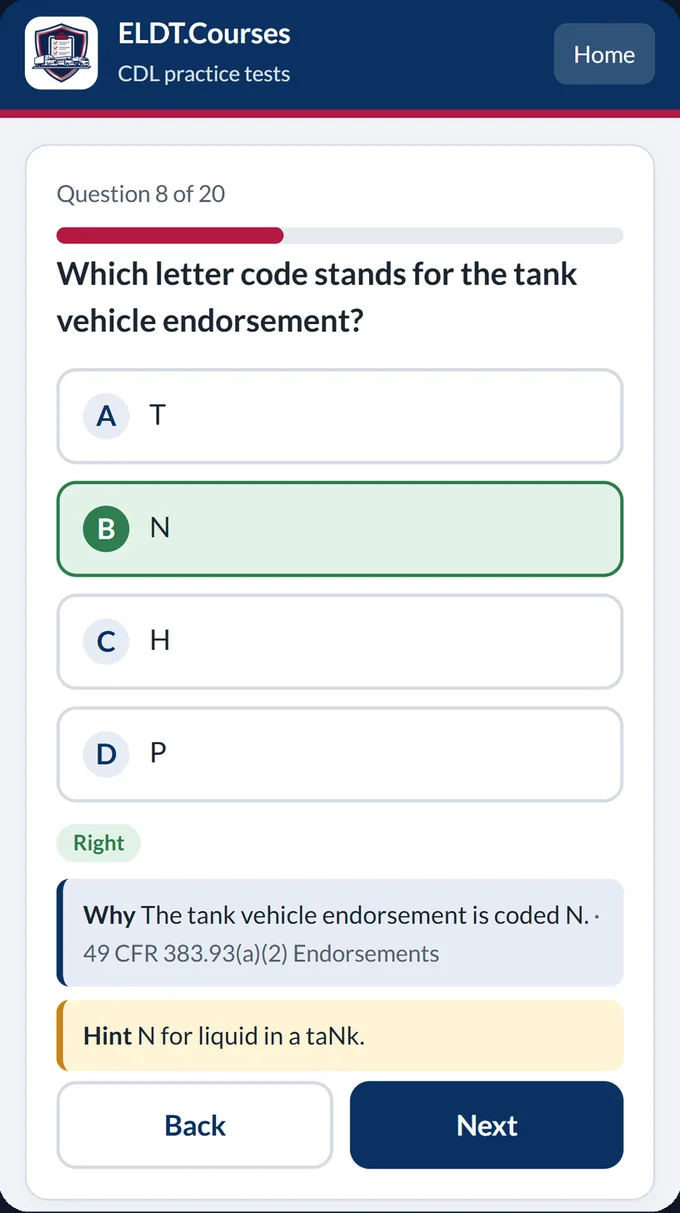
ELDT.Courses is listed on FMCSA's Training Provider Registry as an online theory provider. Search the registry for ELDT.Courses and you will find us, phone number and all: tpr.fmcsa.dot.gov/Search.
Every ELDT completion we report lands on your own driver record there by midnight of the second business day (49 CFR 380.717), so your state can see it before you test.
Each chapter is a narrated lesson. Chapters 2 through 14 each end with a chapter quiz, and the course closes with three practice exams, a final exam and a certificate of completion. Built on 49 CFR Part 382, 49 CFR Part 40, and each agency's own supervisor training rule.
Why the supervisor's job matters, who has to be trained, and how the course meets 49 CFR 382.603.
What reasonable suspicion is and isn't: tips, hunches and rumors, attendance and withdrawal signs, and the cost of getting it wrong.
What alcohol does in the body, why tolerance hides impairment, the 0.02 and 0.04 thresholds, and what Part 382 prohibits.
The four categories of indicators, making the call, and look-alike conditions such as low blood sugar, stroke and head injury.
Screening and confirmation tests, the 2-hour and 8-hour rules, results, records and refusals.
What's on the DOT drug panel, how the test works, fentanyl, marijuana and CBD, and prescriptions.
Reading drug indicators, building a cluster of observations, and telling a stimulant come-down from ordinary fatigue.
How opioids impair, recognizing an overdose and calling 911 first, and PCP and your own safety.
Timing and escort, the urine collection, refusals and shy bladder, the Medical Review Officer, and DOT vs. company forms.
Who's in the room, what to say and never say, removing the employee from safety-sensitive duty, and emergencies.
The deadline, what goes in the record, describing instead of diagnosing, documenting a decision not to test, and retention.
What happens after a violation and how to supervise an employee through return-to-duty and follow-up testing.
Part 40 across the modes, FTA coverage and training under 49 CFR 655.14, and FAA coverage and training under 14 CFR Part 120.
FRA under 49 CFR Part 219, PHMSA under 49 CFR Part 199, USCG under 46 CFR Part 16, and the rulebooks side by side.
The whole course in review, your certificate and records, and the final exam.
15 narrated chapters, chapter quizzes, three practice exams, a final exam and a certificate of completion. Self-paced, lifetime access, direct instructor support.
Enroll Now — $39 →49 CFR 382.603 sets the minimum for anyone designated to supervise CDL drivers. Here's how the course lines up with it.
| 49 CFR 382.603 | This course | |
|---|---|---|
| Alcohol misuse | At least 60 minutes of training | Chapters 3–5: how alcohol impairs, recognizing misuse, and alcohol testing |
| Controlled substances use | At least an additional 60 minutes of training | Chapters 6–9: the DOT drug panel, drug classes, and drug testing |
| What the training covers | Physical, behavioral, speech and performance indicators of probable misuse and use | All four kinds of indicators, for alcohol and for each drug class, with worked examples |
| Recurrent training | Not required for supervisory personnel | Lifetime access for a refresher whenever you want one |
| Other agencies (FTA, FAA, FRA, PHMSA, Coast Guard) | Not covered by Part 382; each agency has its own rule | Chapters 13–14 explain each agency's rule and how it differs. Confirm your agency's requirements. |
Narrated chapters with chapter quizzes, three practice exams and a final exam. Self-paced.
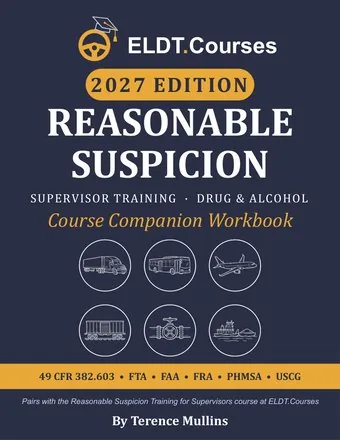
The course workbook is included as a PDF download inside the course at no extra charge.
Shows your name, the completion date, the course title, the provider, and both training components — alcohol misuse and controlled substances.
Stuck on a topic? Email me. You're not a ticket number here.
When federal rules and regulations change, the course is updated — and enrolled students get the updates at no charge.

I spent 10 years as an OTR driver before founding ELDT.Courses. A reasonable suspicion call is one of the hardest decisions a supervisor makes. Miss the signs and an impaired employee goes to work. Act on a hunch and you've ordered a test you can't defend. This course teaches the standard the regulations set — specific, contemporaneous, articulable observations — and what to do from the first sign to the written record.
Every chapter is built on primary sources — the federal regulations in 49 CFR, 14 CFR and 46 CFR and DOT's own guidance — and written fresh, not copied from someone else's training summary. When those rules change, the course is updated.
I've been around commercial trucking long enough to know what the standard endorsement course looks like — a recycled DMV manual, slow narration, and a quiz at the end. Drivers deserve better.
ELDT.Courses is what I wish I'd had when I was studying. Every chapter explains the why, not just the rule. Every quiz pulls from real test material. Every minute is paid for in attention, so I made sure none of them are wasted.
Have a question before you enroll? Pick a time and I will call you. Book a free phone call.
Under 49 CFR 382.603, each employer must ensure that all persons designated to supervise drivers receive reasonable suspicion training. If your company designates you to supervise CDL drivers, you need it before you make a reasonable suspicion call. Transit, aviation, rail, pipeline and maritime employers have their own supervisor training rules. The course explains how each one differs, so check your agency's rule before relying on it.
DOT does not approve or certify supervisor training courses or providers. What matters is whether the training meets the rule, and this course meets the requirements of 49 CFR 382.603: at least 60 minutes of training on alcohol misuse and at least an additional 60 minutes on controlled substances use, covering the physical, behavioral, speech and performance indicators of probable alcohol misuse and use of controlled substances.
No. Entry-level driver training (49 CFR Part 380, Subpart F) is for CDL applicants. This course is for supervisors, under the DOT drug and alcohol testing rules. Nothing is submitted to the Training Provider Registry for this course.
Not automatically. This course is built to meet FMCSA's rule, 49 CFR 382.603. Chapters 13 and 14 explain the supervisor rules of the FTA (49 CFR 655.14), FAA (14 CFR Part 120), FRA (49 CFR Part 219), PHMSA (49 CFR Part 199) and the U.S. Coast Guard (46 CFR Part 16), and where each one differs from FMCSA's. Those rules are not identical. For example, the FAA requires recurrent drug training for supervisors (14 CFR 120.115(c)(4)), and the FRA requires training on its post-accident testing criteria and the supervisor's role in post-accident collections (49 CFR 219.11(g)), which Chapter 14 covers. If your employees fall under one of those agencies, have your program manager confirm the course meets your agency's rule before you rely on it.
Not under FMCSA rules. 49 CFR 382.603 states that recurrent training for supervisory personnel is not required. The FAA is the exception (14 CFR 120.115(c)(4)). A periodic refresher is still a good practice, and your access to the course doesn't expire.
Pass the final exam and you receive a certificate of completion showing your name, the completion date, the course title, the provider, and both training components: alcohol misuse and controlled substances. Give a copy to your safety department or DER. Under 49 CFR 382.401(b)(4), the employer keeps supervisor training records while you supervise and for two years after you stop.
Try it risk-free. If you enroll and decide within 7 days that it's not for you — and you haven't started the course content — just email me and I'll refund you, no questions asked. Once you begin working through the material, the course is yours for life, including all future updates. Full terms are in our Terms of Service.
Related guide, with sources: Is reasonable suspicion refresher training required?
15 chapters. Meets the requirements of 49 CFR 382.603. Certificate of completion. Real instructor support.
It's all in there. The only thing missing is you.
Training several supervisors? Group and volume inquiries welcome — email terry@eldt.courses or call 1-814-304-7635.