
You already completed the Class B ELDT curriculum. FMCSA knows that — and the upgrade path reflects it. This course covers only the additional theory units required to move from a Class B to a Class A CDL: combination vehicles, coupling and uncoupling, doubles and triples, and the handling characteristics that change when you add a trailer. No repeating what you already know.
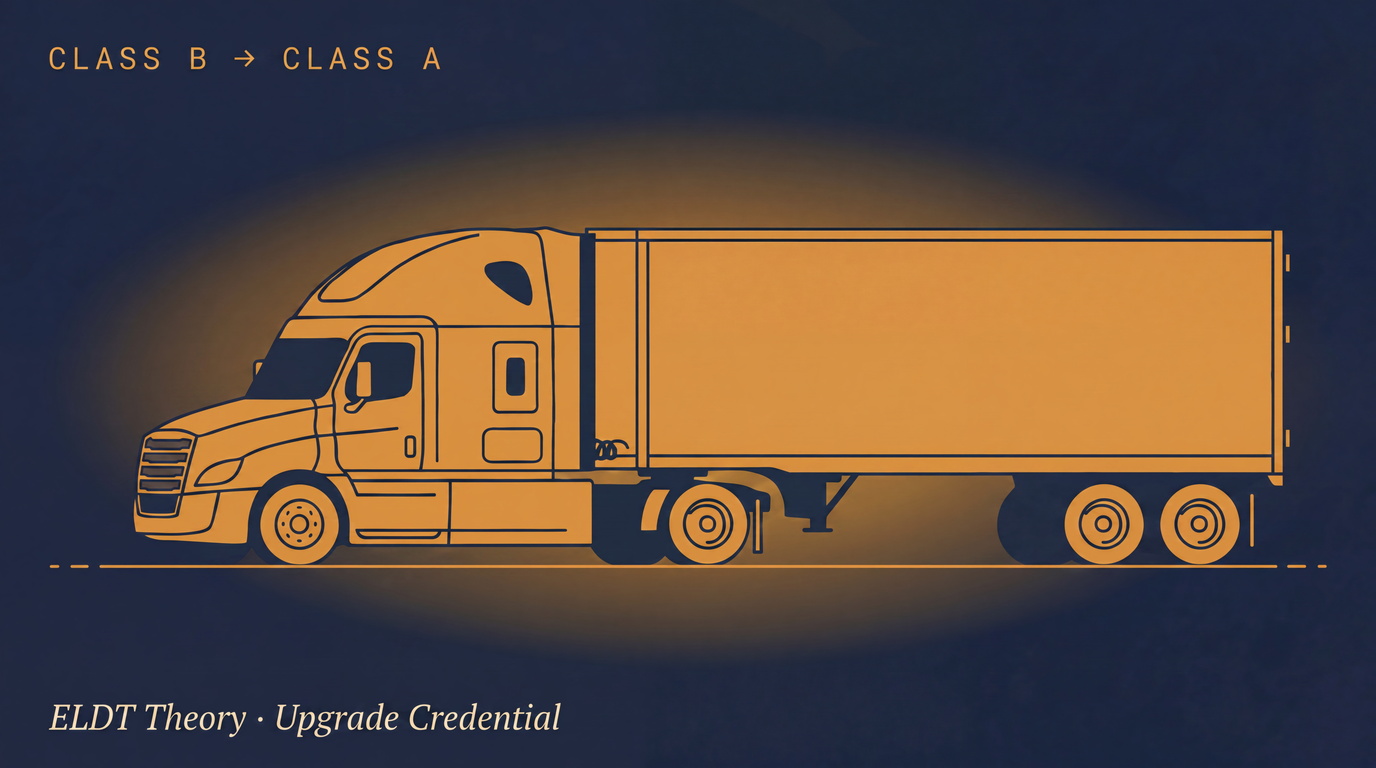
This course is exclusively for drivers who already hold a Class B CDL and are adding a Class A. If you don't yet have a Class B, start with the Class B CDL course first.
Box trucks and straight trucks pay. Tractor-trailers pay more. You've put in the time on the Class B side and you know what's on the other side of that upgrade — more freight options, better lanes, better rates. This is the paperwork step between where you are and where you want to be.
Your employer just added tractor-trailers to the fleet — or picked up a contract that requires Class A drivers. They need you to upgrade. You need to get it done without taking weeks off. This course fits around a working driver's schedule.
Running your own Class B authority is a business. A Class A opens the door to intermodal, dry van, flatbed, and refrigerated freight that your current license can't touch. The upgrade is one of the highest-return moves an owner-operator can make.
FMCSA's upgrade pathway gives credit for the theory training you completed for your Class B. This course covers only the units specific to Class A operation — the combination vehicle knowledge that separates a straight-truck driver from a tractor-trailer driver.
What changes when you add a trailer, how the FMCSA upgrade pathway works, what units carry over from your Class B ELDT, and what the state will require before issuing your Class A CDL.
The complete coupling sequence for a tractor-trailer: approach, kingpin alignment, fifth-wheel inspection, air line connections, electrical connections, landing gear, and the pull-test. Uncoupling in the correct sequence to avoid a dropped trailer or a runaway.
How the Class A pre-trip differs from the Class B. Fifth-wheel components, kingpin and apron, trailer air lines, landing gear, slider rail and locking pins, rear trailer lights and reflectors — every inspection point added by the trailer.
Why tractor-trailers handle differently: off-tracking, the crack-the-whip effect, trailer sway, rearward amplification, and how loaded vs. empty trailers change braking distance and turning radius. The physics your Class B experience didn't cover.
Tractor jackknife vs. trailer jackknife — different causes, different corrections. Anti-lock brake system behavior on combination vehicles and why ABS changes how you respond to a skid.
Why straight-truck backing instincts work against you with a trailer. Straight-line backing, offset backing, alley dock procedures, and sight-side vs. blind-side approaches on a tractor-trailer. The mental model that makes it click.
How doubles and triples differ from a standard combination vehicle. Converter dollies, B-trains, the rearward amplification that makes multi-trailer combinations the most demanding vehicles on the road, and what Class A drivers need to know even if they never pull a set of doubles.
How cargo securement requirements change with trailer type: van, flatbed, drop deck, and refrigerated. Load shift in a trailer vs. a straight truck body, securement points and anchor ratings, and the inspection checkpoints en-route that a Class B driver rarely needed to consider.
Trailer air supply circuits, the trailer hand valve and when not to use it, air line color coding, glad hands and dummy couplers, the trailer parking brake, and what happens to braking performance when you add a fully loaded 53-foot trailer behind an already-heavy tractor.
Class A work typically means long-haul. The 11-hour driving limit, the 14-hour window, the 30-minute break requirement, the 60/70-hour rules, sleeper berth provisions, and how to read and complete an electronic logging device (ELD) record correctly.
Route planning with a trailer: bridge formula weights, posted bridge limits, low clearances, restricted routes, permit loads, and the fuel and rest planning that applies on a multi-day long-haul run that wouldn't come up in a local Class B operation.
Scenario-based review of the Combination Vehicles knowledge test — the exam your state will add to the General Knowledge test you passed for your Class B. The numbers, sequences, and rules the test consistently targets, and your final compliance acknowledgment before TPR submission.
12 focused units. Only what you still need. TPR submitted within two business days of completion.
Enroll Now — $99 →Focused, efficient, and built for a working driver who doesn't have time to sit through material they already know.
| Typical online course | ELDT.Courses | |
|---|---|---|
| Course content | Auto-play video, auto-advance quizzes | Narrated chapters, must complete each topic |
| Built from | Someone else's training summary | Primary source: 49 CFR Part 380, upgrade units only |
| Quiz standard | Varies — often no defined threshold | FMCSA standard: 80%, unlimited retakes |
| Instructor access | None, or a ticket queue | Direct email to a working Class A driver |
| TPR submission | Timing varies, sometimes delayed | Within 2 business days of your completion |
| Content scope | Often repeats Class B material you already know | Upgrade-only units — nothing you've already done |
| Price | $100–$200 for upgrade content | $99 — focused, no filler |
Only the units required for the Class B→A upgrade under 49 CFR Part 380. No re-covering topics you already completed for your Class B. Self-paced, no minimum hours.
Within two business days of your completion, we submit your upgrade ELDT record to the FMCSA Training Provider Registry. Your CDL school and state DMV can then verify your compliance and schedule the Class A skills test.
Each module ends with a quiz built from Combination Vehicles test-style questions. 80% passing threshold, unlimited retakes. The state Combination Vehicles exam won't be a surprise.
Coupling and uncoupling sequence cards, pre-trip inspection additions for combination vehicles, air brake circuit diagrams, and HOS reference cards formatted for the cab.
Questions about the coupling sequence? Confused about rearward amplification? Email terry@eldt.courses directly. A working Class A driver answers — not a support ticket system.
Your access doesn't expire. Review the pre-trip additions the night before your Class A skills test. Come back to the coupling sequence any time you want it fresh.

I know what it means to step up from straight trucks to a tractor-trailer for the first time. The physics change. The backing changes. The coupling procedure is something you have to internalize, not just memorize. The first time you drop a 53-footer into a tight dock on a blind side, you want the theory locked in before you get there — not while you're doing it.
This course is the upgrade curriculum I wish existed when I made the move. Every unit is built on 49 CFR Part 380's upgrade-specific requirements — the exact units FMCSA mandates for a Class B to Class A upgrade, explained the way a driver explains things, not the way a regulator writes them.
You already proved you can handle a Class B. This is the knowledge side of the next step. Get it done, get it documented, and go get the Class A work that's been waiting for you.
Yes — if you obtained your Class B CDL on or after February 7, 2022, or you're upgrading now regardless of when you got your Class B. FMCSA's ELDT regulations require that the upgrade-specific theory units be completed and documented in the Training Provider Registry before you can sit for the Class A skills test. This course satisfies that requirement.
Drivers who held a Class B CDL before the ELDT compliance date may be exempt from the upgrade ELDT requirement depending on their state and circumstances. Check with your state DMV before enrolling to confirm what's required in your situation. If your state requires it, this course covers it correctly.
No. This course satisfies the theory portion of the ELDT upgrade requirement. After we submit your completion to the TPR, you still need to complete behind-the-wheel upgrade training with a licensed CDL school or employer-based program, then pass your state's Class A CDL skills test. This is the knowledge step that comes before the wheel time.
The full Class A CDL course covers the complete ELDT curriculum for a first-time Class A applicant with no prior CDL. This upgrade course covers only the additional units required for drivers who already completed Class B ELDT theory — the combination-vehicle-specific knowledge that the Class B curriculum didn't include. It's shorter, more focused, and priced accordingly at $99 vs. $129.
Most drivers complete it in 6–8 hours of focused work, often across 2–3 sittings. There is no minimum hour requirement — FMCSA requires 100% topic completion, not a seat-hour count. Work at whatever pace fits your schedule.
As soon as your completion is submitted to the TPR and your BTW provider can verify it. We submit completions every business day, Monday through Friday — so in most cases your record is in the TPR the same day or the next business day after you finish. Some CDL schools and motor carriers require TPR verification before scheduling wheel time — completing this course first means no delays when you show up.
When upgrading from Class B to Class A, most states require you to pass the Combination Vehicles knowledge test. You've already passed General Knowledge for your Class B — you typically won't need to retake it. Check your specific state's requirements, but the Combination Vehicles exam is what this course prepares you for.
80%, consistent with the FMCSA standard. Unlimited retakes on any quiz. The goal is that you actually know the material — the quiz is a checkpoint, not a barrier.
Try it risk-free. If you enroll and decide within 7 days that it's not for you — and you haven't started the course content — just email me and I'll refund you, no questions asked. Once you begin working through the modules, the course is yours for life including all future updates. The one hard exception: if your completion has already been submitted to the TPR, that federal record exists and the refund window closes at that point. Full terms are in our Terms of Service.
Yes. terry@eldt.courses goes directly to me. Questions about the coupling sequence, the Combination Vehicles exam, what to expect from a Class A skills test, or anything else — I'll get back to you, usually within 24 hours.
The upgrade units you need. Nothing you've already done. TPR submission within two business days. Lifetime access. Real instructor support from a driver who made this same move.
The theory is the easy part. Let's get it handled.
Upgrading drivers for a fleet expansion or new contract? Employer and volume inquiries welcome — email terry@eldt.courses or call 1-814-304-7635.